
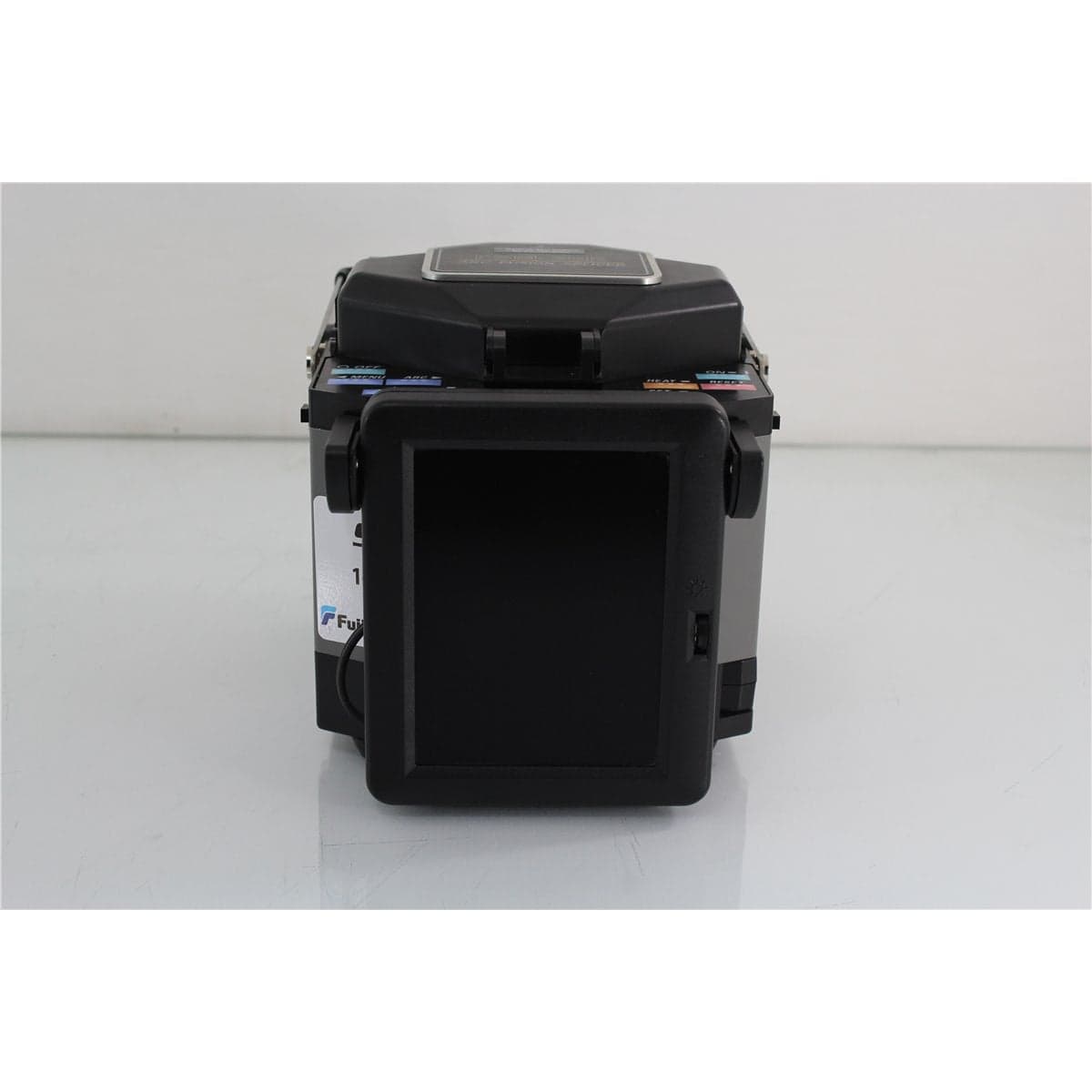
Fujikura · FSM-30R
Fujikura FSM-30R Ribbon Fiber Fusion Splicer with Integrated Sleeve Heater
$2,800.00
Price in USD.
- Condition
- Used
- Availability
- In stock
- Model
- FSM-30R
- Manufacturer
- Fujikura
- Category
- Fusion Splicers
Description
Fujikura FSM-30R Ribbon Fiber Fusion Splicer
The Fujikura FSM-30R is a compact arc fusion splicer designed for mass-fusion splicing of ribbon fibers and splicing of compatible individual optical fibers. Available configurations include the FSM-30R8 for ribbon assemblies containing up to eight fibers and the FSM-30R12 for ribbon assemblies containing up to twelve fibers.
The splicer supports silica-based single-mode, multimode, dispersion-shifted, and non-zero dispersion-shifted optical fibers. It can also accommodate 250 µm UV-coated single fibers, 900 µm nylon-coated single fibers, factory-made ribbon fibers, and compatible groups of individually coated fibers arranged into a ribbon.
A five-inch color LCD presents magnified fiber images, operating menus, splice parameters, inspection results, estimated loss, error information, maintenance functions, and stored splice records. The integrated tube heater shrinks compatible single-fiber and ribbon-fiber protection sleeves after splicing, providing a complete platform for fiber preparation, fusion, proof testing, and splice protection.
Features and Benefits of the Fujikura FSM-30R
The Fujikura FSM-30R provides practical value for technicians and organizations that require reliable ribbon and single-fiber splicing in field, laboratory, production, and network maintenance environments.
- Ribbon fiber capability: The FSM-30R8 supports two- through eight-fiber ribbons, while the FSM-30R12 supports two- through twelve-fiber ribbons.
- Single-fiber operation: Supports compatible 250 µm UV-coated and 900 µm nylon-coated single fibers with the correct holders and preparation tools.
- Multiple fiber types: Provides splice modes for single-mode, multimode, dispersion-shifted, and non-zero dispersion-shifted fibers.
- Typical 40-second splice cycle: Supports efficient mass-fusion splicing during installation, restoration, and production work.
- Automatic arc compensation: Adjusts arc power according to atmospheric pressure for operation at altitudes up to 3500 m.
- X/Y fiber inspection: Uses image processing and two viewing directions to evaluate fiber condition, alignment, cleave angle, gap, and offset.
- Splice-loss estimation: Calculates estimated splice loss using measured fiber offset, angle, core distortion, and other inspection data.
- Integrated proof test: Applies approximately 2 N of proof-test force after splicing.
- Integrated sleeve heater: Shrinks compatible ribbon and single-fiber protection sleeves without requiring a separate heater.
- Splice result memory: Stores up to 150 splice records with estimated loss, fiber offset, errors, cleave angles, arc conditions, and comments.
- Portable power options: Operates from the compatible ADC-07 AC adapter or BTR-04 rechargeable battery pack.
- Field-ready wind protection: Supports operation at wind speeds up to 15 m/s when properly configured and maintained.
Ribbon and Single-Fiber Splicing
The FSM-30R platform is designed primarily for ribbon fiber splicing but also supports individual optical fibers. The exact ribbon capacity depends on the splicer version.
The Fujikura FSM-30R8 accepts two-, four-, five-, six-, and eight-fiber ribbons or equivalent groups of arranged single fibers. The Fujikura FSM-30R12 adds support for ten- and twelve-fiber ribbons while retaining the lower-count splice configurations.
Compatible individual fibers include 250 µm UV-coated fibers and 900 µm nylon-coated fibers. The correct fiber holder and stripping tool are required for each coating diameter. Ribbon fibers require holders matching the number of fibers in the ribbon.
Fiber preparation quality directly affects alignment, arc performance, estimated splice loss, and mechanical reliability. Fibers should be stripped, cleaned with suitable high-purity alcohol, accurately cleaved, and correctly positioned in the V-grooves before the splice cycle begins.
Supported Fiber Types
The FSM-30R provides splice modes for common silica-based telecommunications fibers. Supported fiber categories include:
- Single-mode fiber: Supports compatible fibers represented by ITU-T G.652 sample fibers in the documented performance data.
- Multimode fiber: Supports compatible fibers represented by ITU-T G.651 sample fibers.
- Dispersion-shifted fiber: Supports compatible fibers represented by ITU-T G.653 sample fibers.
- Non-zero dispersion-shifted fiber: Supports compatible fibers represented by ITU-T G.655 sample fibers.
The correct splice mode must be selected for the fiber category and number of fibers. Mixing different fiber constructions, mode field diameters, coatings, ribbon geometries, or manufacturers can affect actual splice performance.
Typical Splice Performance
The documented average splice-loss values are typically 0.05 dB for single-mode fiber, 0.02 dB for multimode fiber, 0.08 dB for dispersion-shifted fiber, and 0.1 dB for non-zero dispersion-shifted fiber.
These values are based on sample fibers corresponding to the listed ITU-T fiber standards under defined test conditions. Actual field results depend on fiber compatibility, fiber preparation, cleave quality, ribbon geometry, cleanliness, electrode condition, arc calibration, ambient conditions, and operator technique.
The splice-loss value displayed by the FSM-30R is an estimate calculated from image-processing measurements. Where certified link performance is required, the completed splice or optical link should be verified using suitable optical test equipment.
Fiber Inspection and Image Processing
A CCD camera captures light passing through the fibers, and the color LCD displays side-view fiber images. During the automated sequence, the splicer advances the fibers, performs a cleaning arc, sets the fiber gap, and checks the fibers before fusion.
The inspection process evaluates fiber offset, cleave angle, end-face gap, fiber count, and visible preparation conditions. The splicer can stop and display an error if a measured value exceeds the limit defined in the selected splice mode.
Operators can switch between X and Y views to examine the fiber ribbon from two directions. Visual inspection remains important because image processing may not identify every fiber defect, contamination issue, or abnormal cleave condition.
Automated Fusion Splicing Process
After prepared fibers are loaded and the wind protector is closed, the FSM-30R performs a controlled sequence that includes fiber advancement, cleaning arc discharge, gap positioning, fiber inspection, fusion arc discharge, and post-splice inspection.
During the arc, the individual fibers should display consistent profiles across the ribbon. Bright points or irregular glowing can indicate contamination on the glass surface. A contaminated fiber may produce core distortion even when the displayed estimated loss is acceptable.
After the splice, the LCD can display individual estimated loss and error results for each fiber in the ribbon. Additional arc discharge is available when appropriate, followed by another X/Y inspection of the completed splice.
Integrated 2 N Proof Test
After the fusion process, the FSM-30R can apply approximately 2 N of proof-test force to the completed splice. This test helps identify a splice that lacks sufficient immediate mechanical integrity before the fiber is transferred to the sleeve heater.
The proof test does not replace correct fiber preparation, protection-sleeve installation, enclosure placement, or final optical testing. The spliced ribbon should be handled with light tension and without bending or twisting while it is transferred to the heater.
Integrated Fiber Protection Sleeve Heater
The FSM-30R includes an integrated tube heater for shrinking compatible protection sleeves over the completed splice. The documented typical shrinking time is approximately 100 seconds for an FP-05 sleeve at an ambient temperature of 25 °C when the splicer is powered by the AC adapter.
Compatible sleeve types include 40 mm ribbon sleeves for assemblies containing up to eight or twelve fibers and 40 mm or 60 mm protection sleeves for single fibers.
The splice point and protection sleeve should be centered in the heater. Ribbon fibers must remain straight and untwisted during heating. The heater cover and retaining clamps help position the assembly while the selected heater program controls the heating and cooling sequence.
Programmable Splice and Heater Modes
The FSM-30R provides 30 programmable areas for splice modes and 10 programmable areas for heater modes. Factory configurations cover supported fiber categories, ribbon counts, and protection-sleeve types.
Editable splice parameters include fiber type, number of fibers, mode title, arc power, arc time, prefuse time, overlap, fiber gap, gap-set position, re-arc time, cleaning arc time, allowable cleave-angle error, allowable fiber offset, gap error, loss estimation, splice-loss error threshold, and mode field diameter.
Editable heater parameters include sleeve type, mode title, heating time, heating temperature, and cooling finish temperature. Factory settings should normally be used with compatible Fujikura protection sleeves unless an application requires a validated alternative configuration.
Arc Test and Atmospheric Compensation
Optimized arc power is necessary for consistent splice performance. The FSM-30R includes an Arc Test function that evaluates fiber melt-back and automatically revises the current splice mode when the arc power or electrode position requires adjustment.
An Arc Test should be performed before daily splicing, after changing the splice mode, and after replacing the electrodes. Repeating the Arc Test until the system reports an acceptable result helps reduce melt-back variation.
The splicer also provides automatic arc-power compensation based on atmospheric pressure. This function supports operation at altitudes up to 3500 m, although an Arc Test remains important when environmental conditions change.
Splice Result Memory
The Fujikura FSM-30R stores up to 150 splice results in internal memory. Stored information can include the selected splice mode, estimated splice loss, error messages, fiber offset, left and right cleave angles, arc power, arc time, overlap, and related splice conditions.
A comment of up to 22 characters can be added to a result. This feature can help identify cable sections, fiber groups, closures, work orders, operators, or production batches.
When all 150 memory positions have been used, the system returns to the first position and begins overwriting previous records. Records can be reviewed through the memory menu and can be cleared individually by range or cleared completely when the function is enabled.
Five-Inch Color LCD and User Interface
The integrated five-inch color LCD displays the fiber images, splice and heater modes, battery condition, inspection data, estimated loss, menu options, diagnostic results, and maintenance information.
Dedicated controls provide access to power, setup, splice initiation, arc functions, sleeve heating, menu navigation, reset, and X/Y image views. The user interface supports routine operation as well as adjustable splice, heater, utility, and maintenance functions.
Supervisor settings can restrict access to mode editing, mode selection, memory deletion, maintenance functions, repeated arcs, and power-saving parameters. A company name and comment can also be configured for display during startup.
Battery and AC Operation
The FSM-30R operates from the compatible Fujikura ADC-07 AC adapter and battery charger or the BTR-04 rechargeable battery pack. The ADC-07 accepts input from 100 V to 240 V AC at 50 Hz to 60 Hz.
The BTR-04 is a 12 V, 2800 mAh nickel-cadmium battery pack. Typical charging time is approximately two hours using the ADC-07 and DCC-08 battery charger cord, depending on remaining battery capacity and condition.
The power-saving menu can turn off the monitor or splicer after periods of inactivity. Battery operating time depends on battery age, condition, ambient temperature, heater use, splice frequency, maintenance history, and power-saving settings.
Maintenance and Diagnostic Functions
The FSM-30R includes maintenance functions that support splice quality and help identify operational problems.
- Dust check: Inspects the X and Y optical paths for contamination that could interfere with image processing.
- Diagnostic test: Checks illumination, Z-motor operation, optical-path cleanliness, fiber overlap, arc function, gap position, I/O ports, and memory.
- Arc counter: Tracks electrode use since the most recent counter reset.
- Total arc counter: Records the total number of arc discharges performed by the splicer.
- Electrode replacement mode: Guides electrode installation, stabilization, Arc Test, and counter reset.
- Manual motor operation: Allows the left and right Z-motors to be moved for maintenance and inspection.
- Battery discharge function: Supports complete discharge of the NiCd battery pack to help manage memory effect.
Typical Applications
The Fujikura FSM-30R is suitable for professional applications such as:
- Ribbon fiber cable installation
- Mass-fusion splicing of telecommunications fibers
- Fiber optic network construction
- Outside-plant cable restoration
- Data center and backbone fiber deployment
- Fiber optic closure and enclosure work
- Single-mode and multimode cable splicing
- Dispersion-shifted fiber splicing
- Production and cable assembly workflows
- Laboratory fiber preparation
- Network maintenance and emergency repair
- Training and technical service environments
Product Overview
| Brand | Fujikura |
| Model | FSM-30R |
| Product Category | Ribbon Fiber Arc Fusion Splicer |
| Model Variants | FSM-30R8 and FSM-30R12 |
| Ribbon Capacity | Up to 8 or 12 fibers, depending on the model configuration |
| Supported Fiber Types | Single-mode, multimode, dispersion-shifted, and non-zero dispersion-shifted silica fibers |
| Single-Fiber Support | 250 µm UV-coated and 900 µm nylon-coated fibers with compatible holders |
| Display | Five-inch color LCD |
| Proof-Test Force | Approximately 2 N |
| Splice Memory | 150 results |
| Primary Application | Mass-fusion splicing of ribbon fibers and splicing of compatible single fibers |
Splicing Specifications
| Specification | Details |
| Applicable Fiber Material | Silica-based optical fiber |
| Supported Fiber Categories | SM, MM, DS, and NZ-DS |
| FSM-30R8 Ribbon Capacity | 2 to 8 fibers |
| FSM-30R12 Ribbon Capacity | 2 to 12 fibers |
| Single-Fiber Coating Types | 250 µm UV coating and 900 µm nylon coating |
| Typical Splicing Time | 40 seconds |
| Arc-Power Compensation | Automatic compensation based on atmospheric pressure |
| Maximum Supported Altitude | 3500 m |
| Proof-Test Force | Approximately 2 N |
| Programmable Splice Modes | 30 areas |
Typical Average Splice Loss
| Fiber Type | Typical Average Splice Loss | Referenced Sample Fiber Standard |
| Single-Mode Fiber | 0.05 dB | ITU-T G.652 |
| Multimode Fiber | 0.02 dB | ITU-T G.651 |
| Dispersion-Shifted Fiber | 0.08 dB | ITU-T G.653 |
| Non-Zero Dispersion-Shifted Fiber | 0.1 dB | ITU-T G.655 |
Sleeve Heater Specifications
| Specification | Details |
| Heater Type | Integrated tube heater |
| Typical Shrinking Time | Approximately 100 seconds using an FP-05 sleeve at 25 °C with the AC adapter |
| Programmable Heater Modes | 10 areas |
| Ribbon Sleeve for Up to 8 Fibers | Fujikura FP-04(T), 40 mm |
| Ribbon Sleeve for Up to 12 Fibers | Fujikura FP-05, 40 mm |
| Single-Fiber Sleeve | Fujikura FP-03, 60 mm |
| Compact Single-Fiber Sleeve | Fujikura FP-03, 40 mm version |
Memory and Display Specifications
| Specification | Details |
| Display | Five-inch color LCD |
| Fiber Views | X and Y side views |
| Splice Result Capacity | 150 records |
| Stored Result Data | Estimated loss, fiber offset, error, cleave angle, arc conditions, and comment |
| Comment Length | Up to 22 characters |
| Maintenance Data | Serial number, arc count, total arc count, maintenance dates, and software version |
Power and Physical Specifications
| Specification | Details |
| Compatible AC Adapter and Charger | Fujikura ADC-07 |
| AC Input | 100 V to 240 V AC, 50 Hz to 60 Hz |
| Compatible Battery Pack | Fujikura BTR-04 |
| Battery Chemistry | Nickel-cadmium |
| Battery Rating | 12 V, 2800 mAh |
| Typical Battery Charge Time | Approximately two hours |
| Dimensions | 150 mm wide x 150 mm deep x 150 mm high |
| Weight with AC Adapter | Approximately 2.8 kg |
| Weight with Battery Pack | Approximately 3.3 kg |
| Maximum Permissible Wind Speed | 15 m/s |
Compatible Fiber Holders and Preparation Tools
| Fiber or Accessory Type | Compatible Item |
| 250 µm Single Fiber | FH-250 fiber holder and PS-02 primary coating stripper |
| 900 µm Single Fiber | FH-900 fiber holder and JS-01 jacket stripper |
| Ribbon Fiber | FH-2, FH-4, FH-5, FH-6, FH-8, FH-10, or FH-12 holder as applicable |
| Ribbon Coating Removal | Fujikura HJS-02 hot jacket stripper |
| Fiber Cleaving | Fujikura CT-20 fiber cleaver |
| Arranged Single Fibers | Fujikura FAT-04 fiber arrangement tool |
| Replacement Electrodes | Fujikura ELCT2-16, replaced as a matched pair |
Original System Components and Options
| Item | Model or Description |
| Fusion Splicer | Fujikura FSM-30R |
| AC Adapter and Battery Charger | ADC-07 |
| Battery Pack | BTR-04 |
| Battery Charger Cord | DCC-08 |
| AC Power Cord | ACC-01 or regional equivalent |
| Replacement Electrodes | One pair of ELCT2-16 electrodes |
| Carrying Case | CC-01 |
| Monitor Cover | MC-01 |
| Optional Magnifier | MGS-03 |
| Optional J-Plate | JP-02A |
| Optional Top Cover | TC-01A |
Model Configuration and Compatibility Considerations
Buyers should confirm whether the unit is an FSM-30R8 or FSM-30R12. The FSM-30R8 supports ribbon counts up to eight fibers, while the FSM-30R12 supports ribbon counts up to twelve fibers.
The correct holders are required for each ribbon count or single-fiber coating diameter. A splicer without the necessary holders, stripper, cleaver, and protection sleeves is not a complete ribbon-splicing system.
Tools and accessories supplied with an individual unit may differ from the original factory package. Fiber holders, the CT-20 cleaver, HJS-02 hot jacket stripper, battery, charger, carrying case, spare electrodes, and sleeves should not be considered included unless identified in the product listing.
The BTR-04 is a legacy NiCd battery. Available capacity can be affected by age, charge history, storage, temperature, memory effect, and cell condition. Battery runtime should be evaluated separately from basic splicer operation.
Comprehensive Functional and Performance Testing
The Fujikura FSM-30R receives comprehensive functional and performance testing before shipment. Testing may include power-up, five-inch color LCD operation, panel keys, X/Y image views, wind-protector detection, illumination, left and right Z-motor movement, fiber-guide movement, arc discharge, proof-test operation, tube-heater function, video output, and hot-jacket-stripper DC output.
The optical system may be checked for dust, image artifacts, focus, illumination balance, and reliable recognition of properly prepared fibers. V-grooves, fiber clamps, wind-protector mirrors, objective lenses, electrodes, and heater surfaces may be inspected and cleaned as required.
Splicing tests may include fiber advancement, cleaning arc, gap positioning, cleave-angle inspection, offset measurement, fusion, estimated-loss calculation, proof testing, re-arc operation, and storage of splice results.
The diagnostic menu may also be used to test X/Y illumination, Z-motors, dust condition, overlap, Arc Test results, gap-set position, I/O functions, and memory. The exact testing scope depends on available fibers, ribbon holders, cleaver, stripper, protection sleeves, battery, charger, and other accessories.
Electrode and Maintenance Considerations
The electrode arc counter should be checked before the splicer is placed into service. The documented maintenance procedure recommends replacing both ELCT2-16 electrodes as a pair when the arc count reaches approximately 1000.
After electrode replacement, the splicer performs an electrode-stabilization routine using repeated arc discharges, followed by an Arc Test. The replacement function also clears the electrode arc counter.
Routine cleaning of the V-grooves, fiber clamps, wind-protector mirrors, objective lenses, cleaver blade, and hot jacket stripper is important for maintaining image-processing reliability and splice performance. Only suitable high-purity alcohol and approved cleaning materials should be used.
Buyer Considerations
Buyers should confirm the exact FSM-30R model, supported ribbon capacity, arc count, total arc count, electrode condition, software version, optical-path condition, heater operation, battery condition, and included fiber holders.
The condition of the V-grooves, fiber clamps, objective lenses, wind-protector mirrors, electrodes, LCD, keyboard, tube heater, power-unit dock, video output, carrying case, cleaver, stripper, and charging equipment should be reviewed before purchase.
Only the splicer, AC adapter, battery, charger cord, power cord, fiber holders, cleaver, stripper, electrodes, protection sleeves, carrying case, manual, and accessories specifically identified in the product listing should be considered included.
Why Buy from AssetRelay?
AssetRelay supplies professional equipment and product solutions for fiber optic installation, telecom network deployment, laboratory testing, production, inspection, cleaning, electronic test, RF/microwave, and photonics applications. The Fujikura FSM-30R supports installers, technicians, service organizations, laboratories, cable manufacturers, and network operators that require ribbon and single-fiber fusion splicing capability.
Buyers should review the available product photographs, physical condition, FSM-30R8 or FSM-30R12 configuration, arc count, electrode condition, battery status, included holders, preparation tools, heater operation, testing information, and accessories before purchase.
Only the equipment and accessories specifically identified in the individual product listing should be considered included.