
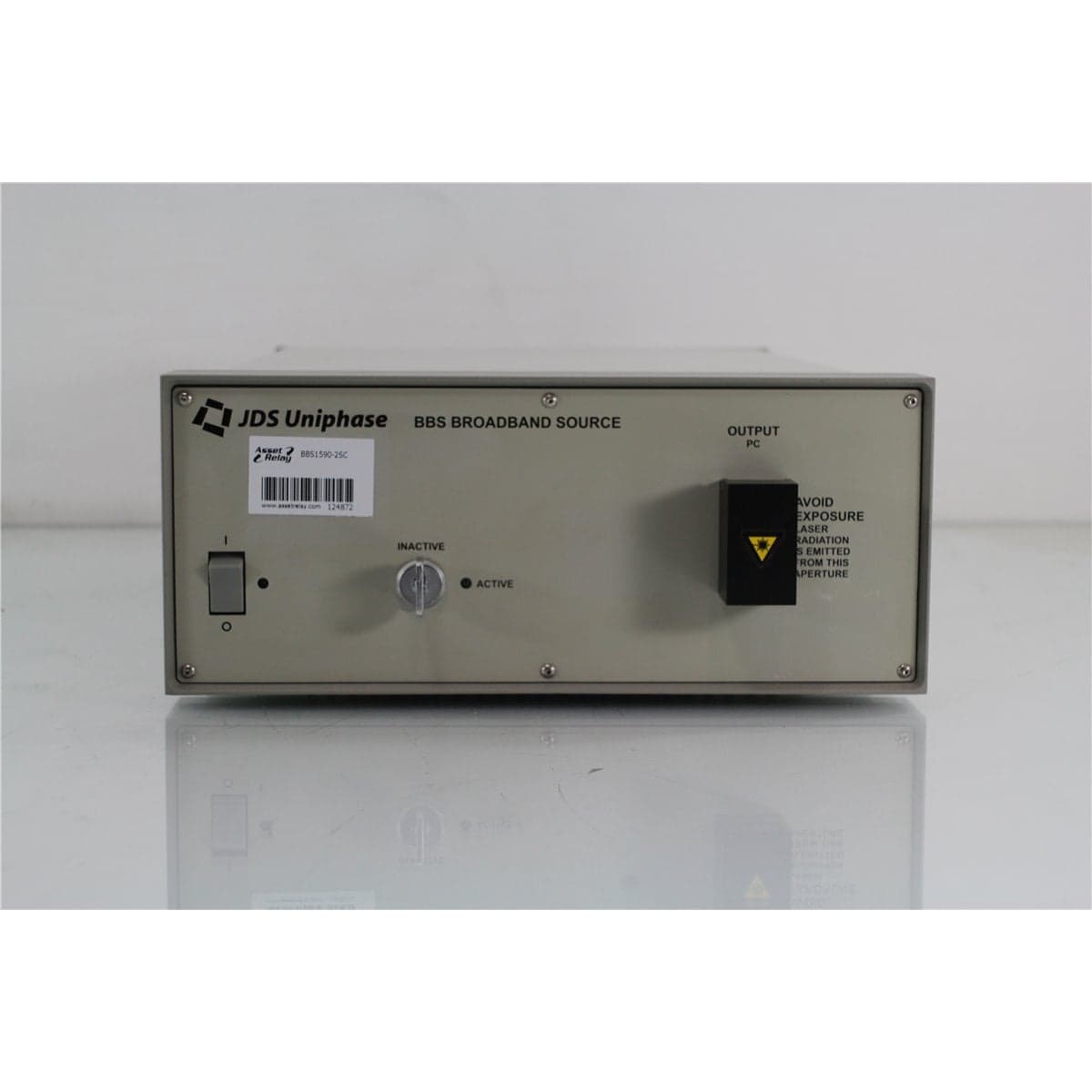
JDS · BBS1590-2SC
JDSU BBS-1590-2SC00 L-Band High-Power Broadband Source, 1565–1610 nm, SC/PC
$2,400.00
Price in USD.
- Condition
- Used
- Availability
- In stock
- Model
- BBS1590-2SC
- Manufacturer
- JDS
- Category
- BBS, EELED
Description
JDSU BBS-1590-2SC00 L-Band High-Power Broadband Source, 1565–1610 nm, SC/PC
The JDSU BBS-1590-2SC00 is a high-power broadband optical source designed for professional spectral testing of single-mode fiber optic components, subsystems, and communication equipment. This BBS1590 configuration operates across the L-band wavelength range from 1565 nm to 1610 nm and uses a gain-flattened amplified spontaneous emission spectrum to support broadband optical measurements.
The BBS-1590-2SC00 provides more than 20 mW of total optical output power and uses a standard single SC/PC output connector. Its compact half-rack benchtop enclosure can also be installed in a standard 19-inch equipment rack using the appropriate rackmount kit.
Through optimization of spectral power density, spectral uniformity, and optical stability, the JDSU broadband source supports optical component spectral measurements and system compliance tests in research, development, engineering, and manufacturing environments. The broad L-band output is useful for evaluating devices that cannot be completely characterized with a single narrow-linewidth laser source.
Features and Benefits of the JDSU BBS-1590-2SC00
The JDSU BBS-1590-2SC00 provides a broad, stable optical spectrum for engineers, laboratories, production facilities, and service organizations working with L-band optical components and systems.
- L-band broadband output: Covers wavelengths from 1565 nm to 1610 nm for long-wavelength optical testing.
- Gain-flattened spectrum: Uses amplified spontaneous emission from optically pumped erbium-doped fiber to produce a broad, flattened optical output.
- More than 20 mW total power: Provides sufficient broadband optical power for component characterization and system measurements.
- Maximum spectral gain flatness of 1.8 dB: Supports more consistent spectral measurements across the documented gain-flattened range.
- Stable optical output: Provides total output-power stability of 0.02 dB over one hour under the specified conditions.
- High output isolation: Provides a minimum output isolation of 45 dB.
- SC/PC connectivity: Uses a standard straight-contact SC optical output for compatible single-mode fiber systems.
- Compact benchtop format: Occupies half-rack width and supports installation in a standard 19-inch rack.
- Universal AC input: Operates from 100 V AC to 240 V AC at 50 Hz to 60 Hz.
- Research and manufacturing use: Suitable for optical component development, production screening, system compliance testing, sensors, and imaging applications.
Gain-Flattened L-Band Optical Spectrum
The JDSU BBS1590 uses optically pumped erbium-doped fiber to produce amplified spontaneous emission across the L-band. The optical spectrum is flattened to provide broadband output with controlled spectral variation over the applicable wavelength region.
The complete operating wavelength range extends from 1565 nm to 1610 nm. Within this range, the documented gain-flattened region extends from 1570 nm to 1603 nm. Maximum spectral gain flatness is specified at 1.8 dB for the BBS1590 model.
A broadband source differs from a tunable laser or fixed-wavelength laser because it emits optical energy across a continuous wavelength range. This allows a compatible analyzer or detector system to observe the wavelength-dependent response of an optical component without selecting and stepping through individual narrow-linewidth channels.
High-Power Broadband Output
The BBS-1590-2SC00 provides more than 20 mW of total optical output power. The documented L-band power is measured at 1586 nm and an ambient temperature of 23 °C.
Broadband output power is distributed across the source spectrum rather than concentrated at a single wavelength. When selecting detectors, optical spectrum analyzers, attenuators, and devices under test, users should consider both total optical power and spectral power density.
The expected power at the device under test also depends on connector loss, patch-cord attenuation, optical splitting, external filtering, and the spectral response of the complete measurement setup.
Optical Power Stability
Total optical output-power stability is specified at 0.02 dB over one hour at 23 °C after a one-hour warm-up period. Stable broadband output supports repeatable spectral measurements and comparisons between optical components.
Actual stability can be influenced by warm-up time, ambient temperature, fiber movement, connector cleanliness, backreflection, and the condition of the source. Patch cords should remain stationary during precision measurements, and the source should be allowed to stabilize before references or baseline measurements are recorded.
Optical Component Spectral Testing
The JDSU BBS-1590-2SC00 can provide broadband illumination for evaluating the wavelength-dependent characteristics of passive and active optical components. The source can be connected to a device under test, while a compatible optical spectrum analyzer or wavelength-resolved measurement system observes the transmitted or reflected spectrum.
This method can support evaluation of optical filters, couplers, splitters, wavelength-selective devices, fiber Bragg gratings, amplifier components, and other devices whose performance changes with wavelength.
The source itself generates the broadband optical signal but does not analyze the resulting spectrum. A suitable receiving instrument is required to measure insertion loss, spectral response, passband shape, isolation, ripple, or other wavelength-dependent characteristics.
System Compliance Testing
The broad L-band optical output can be used in system-level compliance and performance testing. It can help evaluate whether an optical path, subsystem, or integrated component maintains the required response across its operating wavelength range.
The source may be combined with optical attenuators, switches, power meters, spectrum analyzers, couplers, and other equipment to create an application-specific measurement system. The exact setup depends on the device under test and the parameters being evaluated.
Sensor and Imaging Applications
The JDSU BBS-1590-2SC00 is also suitable for compatible optical sensor and imaging applications that require broadband illumination in the 1565 nm to 1610 nm region. The flattened spectrum can provide a useful source for evaluating wavelength-dependent sensing elements and optical assemblies.
Compatibility should be confirmed based on the required wavelength range, optical power, connector type, spectral density, detector response, and safety requirements of the intended application.
Typical Applications
The JDSU BBS-1590-2SC00 Broadband Source is suitable for professional applications such as:
- L-band optical component spectral testing
- Optical system compliance testing
- Optical filter characterization
- WDM and DWDM component evaluation
- Fiber Bragg grating testing
- Optical coupler and splitter analysis
- Optical amplifier component testing
- Wavelength-dependent insertion-loss measurements
- Sensor development and testing
- Compatible optical imaging applications
- Photonics research and development
- Production testing and quality control
Product Overview
| Brand | JDSU / JDS Uniphase |
| Model | BBS-1590-2SC00 |
| Base Model | BBS1590 |
| Product Category | High-Power Broadband Optical Source |
| Optical Band | L-band |
| Broadband Generation Method | Gain-flattened amplified spontaneous emission from optically pumped erbium-doped fiber |
| Output Configuration | Standard single optical output |
| Connector Type | SC/PC |
| Primary Application | Broadband spectral testing of L-band optical components and systems |
| Suitable For | Optical laboratories, telecom research, component characterization, production testing, sensors, imaging, and photonics development |
BBS1590 Optical Specifications
| Specification | JDSU BBS-1590-2SC00 Details |
| Test Band | L-band |
| Operating Wavelength Range | 1565 nm to 1610 nm |
| Gain-Flattened Spectrum | Yes |
| Gain-Flattened Range | 1570 nm to 1603 nm |
| Minimum Total Optical Power | Greater than 20 mW |
| Power Measurement Reference | Measured at 1586 nm and 23 °C |
| Maximum Spectral Gain Flatness | 1.8 dB |
| Total Output-Power Stability | 0.02 dB over one hour at 23 °C after one hour of warm-up |
| Minimum Output Isolation | 45 dB |
| Output Connector | SC/PC |
BBS-1590-2SC00 Configuration Details
| Configuration Field | Selected Configuration |
| Product Family | BBS Benchtop Broadband Source |
| Model Code | 1590 |
| Model Description | L-band broadband source, 1565 nm to 1610 nm |
| Connector Code | SC |
| Connector Type | SC/PC |
| Output Configuration Code | 0 |
| Output Configuration | Standard single output connector |
| Output-Power Code | 0 |
| Output-Power Configuration | Standard BBS1590 output power |
Electrical, Environmental, and Mechanical Specifications
| Specification | Details |
| Input Voltage | 100 V AC to 240 V AC |
| Line Frequency | 50 Hz to 60 Hz |
| Maximum Power Consumption | 90 VA |
| Packaging | Half-rack benchtop enclosure with 19-inch rackmount capability |
| Dimensions | 21.2 cm wide x 8.9 cm high x 35.5 cm deep |
| Weight | Less than 4 kg |
| Operating Temperature | 0 °C to 50 °C |
| Storage Temperature | -40 °C to 70 °C |
| Humidity | Maximum 95% relative humidity, non-condensing, from 0 °C to 45 °C |
| Warm-Up for Stability Specification | One hour |
SC/PC Optical Output
The JDSU BBS-1590-2SC00 uses an SC/PC optical output. Compatible straight-contact SC/PC single-mode patch cords should be used when connecting the source to a device under test or measurement system.
SC/PC and SC/APC connectors use different end-face geometries and should not be mated directly. The connector polish should be verified before connection to prevent physical damage and degraded optical performance.
All fiber connector end faces should be inspected and cleaned before mating. Contamination can reduce transmitted power, increase backreflection, introduce spectral variation, and transfer debris to the source output interface.
Measurement Preparation
The JDSU BBS-1590-2SC00 should complete a one-hour warm-up before measurements requiring the stated output-power stability. The optical output should remain protected or connected to a compatible optical path whenever the source is enabled.
The receiving equipment should be suitable for the 1565 nm to 1610 nm wavelength range and the available optical power. External attenuation or splitting may be required to protect sensitive detectors or distribute the source among multiple instruments.
Patch cords should remain stationary during precision measurements. Fiber movement, connector contamination, temperature changes, and backreflection can affect the optical power and measured spectral response.
Laser Safety
The JDSU broadband source is classified as a Class 3B laser product under IEC 60825-1 and complies with the applicable laser product requirements identified for the instrument. Invisible laser radiation may be present at the optical output.
Users should avoid exposure to the optical beam and should never look directly into the source output or the end of a connected fiber. Viewing the output through optical instruments can increase the potential hazard.
The source should be operated only by trained personnel using appropriate laser-safety procedures, warning controls, protective covers, and compatible fiber optic equipment.
Calibration and Testing Before Shipment
When calibration is technically applicable and supported, the JDSU BBS-1590-2SC00 is calibrated before shipment. The calibration process may include verification of operating wavelength range, total optical output power, spectral gain flatness, output-power stability, output isolation, and SC/PC optical interface performance.
Following successful calibration, the instrument may include a calibration label, calibration certificate, and related calibration data, depending on the equipment configuration and calibration service.
If formal calibration is unavailable or not applicable to the specific instrument, the unit receives comprehensive functional and performance testing. This process may include optical output verification, broadband spectral-response evaluation, output stability testing, connector inspection, power switch and indicator checks, and basic electrical operation.
This testing helps verify that the equipment operates correctly and that its available functions have been evaluated before it is released for shipment. The exact calibration scope, documentation, spectral data, test results, and included service records should be confirmed before purchase when these items are required for laboratory, production, regulatory, or quality-management applications.
Buyer Considerations
The JDSU BBS-1590-2SC00 is specifically an L-band broadband source. Buyers should confirm that the 1565 nm to 1610 nm operating range, greater than 20 mW total optical power, SC/PC output, spectral flatness, and Class 3B laser designation match the intended application.
The BBS1590 should not be confused with the BBS1550 C-band source or BBS1560 C+L-band source. Each model has a different operating wavelength range, gain-flattened region, total optical output, and spectral-flatness specification.
Buyers should review the instrument’s physical condition, SC/PC interface, optical output, spectral performance, cooling, indicators, power input, calibration status, and included accessories. Only items specifically identified in the product listing should be considered included.
Why Buy from AssetRelay?
AssetRelay supplies professional equipment and product solutions for fiber optic, telecom, laboratory, production, inspection, cleaning, RF/microwave, electronic test, and photonics applications. The JDSU BBS-1590-2SC00 Broadband Source is listed to help engineers, laboratory personnel, production facilities, procurement teams, and service organizations source L-band broadband optical source equipment for professional test systems.
Buyers should review the available product photographs, physical condition, SC/PC output, included accessories, calibration information, and application requirements before purchase. Confirming these details helps ensure that the source matches the intended wavelength range, optical power, spectral requirements, connector polish, and measurement workflow.
Only accessories specifically identified in the product listing should be considered included. SC/PC patch cables, optical attenuators, spectrum analyzers, power meters, splitters, cleaning supplies, and additional rack hardware may be required separately.