
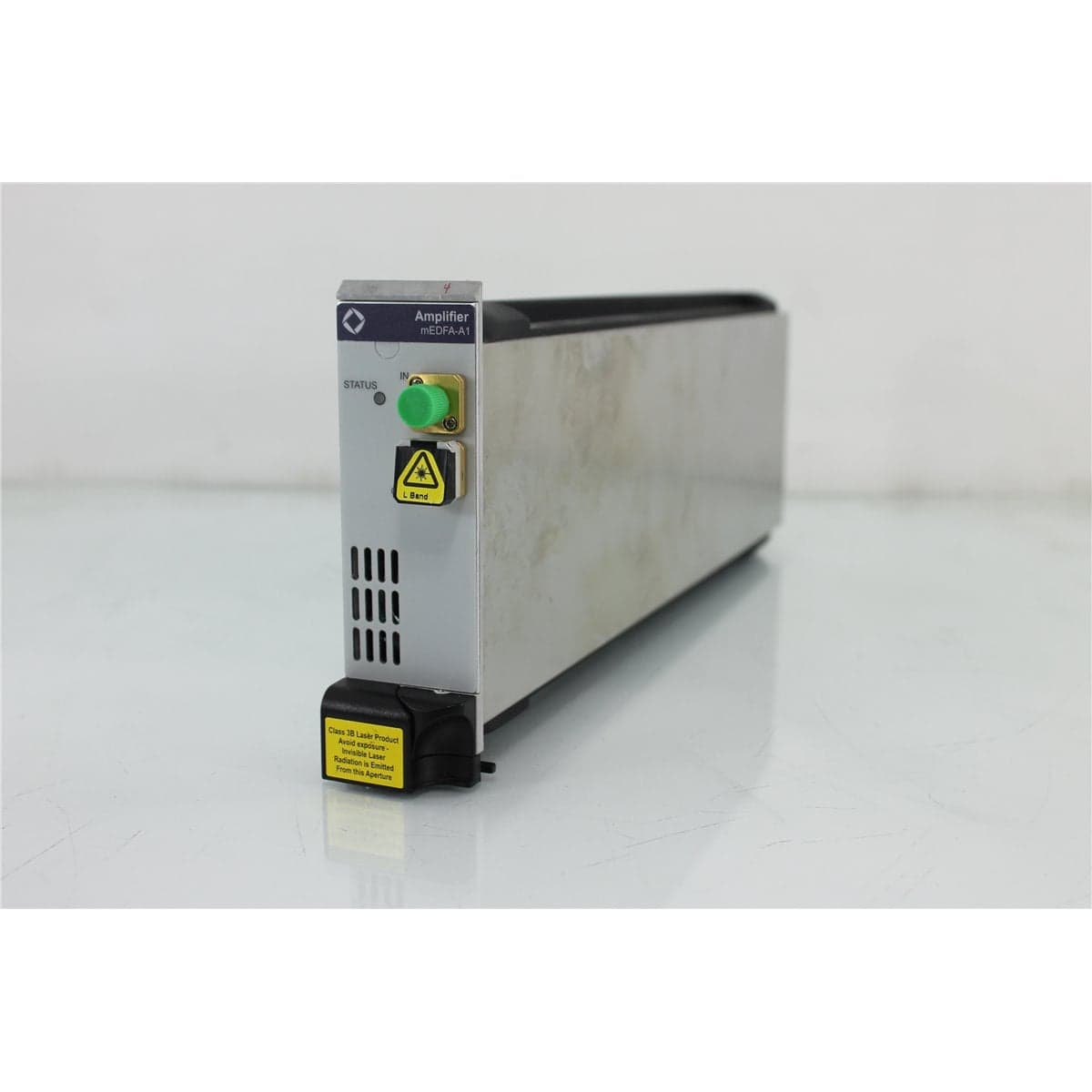
JDS · mEDFA-A15900
JDSU mEDFA-A15900 MAP L-Band Single-Channel Erbium-Doped Fiber Pre-Amplifier
$3,352.00
Price in USD.
- Condition
- New (open box)
- Availability
- In stock
- Model
- mEDFA-A15900
- Manufacturer
- JDS
- Category
- L-Band EDFAs
Description
JDSU mEDFA-A15900 MAP L-Band Single-Channel Erbium-Doped Fiber Pre-Amplifier
The JDSU mEDFA-A15900 is an L-band erbium-doped fiber amplifier module designed for the JDSU Multiple Application Platform. This configuration functions as a single-channel optical pre-amplifier and supports operation across wavelengths from 1565 nm to 1610 nm.
The mEDFA-A15900 provides greater than 15 dBm of saturated output power, greater than 24 dB of small-signal gain, and a maximum noise figure below 5.0 dB under the documented measurement conditions. Its pre-amplifier configuration is suitable for increasing the level of compatible L-band optical signals before detection, analysis, or additional processing.
The module is intended for installation in a compatible JDSU MAP platform and is not a standalone benchtop amplifier. When installed in a suitable MAP-200 chassis, the mEDFA-A15900 can be combined with other compatible photonic modules and incorporated into automated laboratory and manufacturing systems.
Features and Benefits of the JDSU mEDFA-A15900
The JDSU mEDFA-A15900 provides practical L-band optical amplification for engineers and technical teams working with modular fiber optic test systems.
- L-band pre-amplifier configuration: Designed to increase the level of compatible single-channel optical signals before detection, measurement, or further processing.
- 1565 nm to 1610 nm operating range: Supports optical amplification across the L-band wavelength region.
- Greater than 15 dBm saturated output power: Provides useful optical output for pre-amplifier emulation and system-level experiments.
- Greater than 24 dB small-signal gain: Supports applications involving comparatively weak L-band input signals.
- Maximum noise figure below 5.0 dB: Helps limit additional optical impairment introduced during amplification.
- Low polarization-dependent loss: Maximum PDL below 0.3 dB helps limit gain variation associated with changes in the input polarization state.
- Low polarization-mode dispersion: Maximum PMD below 0.6 ps supports demanding optical transmission and component-testing applications.
- Typical output isolation of 40 dB: Helps protect the amplifier from optical reflections returning through the output path.
- Modular MAP format: Installs in a compatible JDSU MAP platform for configurable photonic-layer testing.
- Automation support: Can be automated when used with compatible MAP-200 LXI interfaces and IVI drivers.
L-Band Single-Channel Pre-Amplifier
The mEDFA-A15900 is configured as a single-channel L-band pre-amplifier. A pre-amplifier is commonly positioned before a receiver, detector, analyzer, or other downstream element to increase the strength of a low-level optical signal.
The documented operating wavelength range extends from 1565 nm to 1610 nm. This range supports compatible L-band communication systems, optical components, transmission experiments, and laboratory measurement setups.
The pre-amplifier configuration differs from the booster and in-line versions offered in the mEDFA-A1 family. Booster amplifiers are generally used to increase optical launch power, while pre-amplifiers are intended to increase weaker signals before detection or additional signal processing.
Small-Signal Gain and Output Power
The JDSU mEDFA-A15900 provides minimum small-signal gain greater than 24 dB. This specification is measured with an input power of -20 dBm under the documented conditions.
The minimum saturated output power is greater than 15 dBm. The documented saturated output-power measurement is taken at 1590 nm with an input power of 0 dBm under mid-span test conditions.
These capabilities support L-band transmission experiments, weak-signal amplification, receiver evaluation, optical loss compensation, and system emulation. Actual amplifier performance depends on input wavelength, input power, connector condition, operating temperature, and the configuration of the complete optical system.
Users should confirm that downstream equipment can accommodate the amplified output level. An external optical attenuator may be required when the connected detector, analyzer, receiver, or device under test has a lower maximum input-power rating.
Low-Noise L-Band Amplification
The mEDFA-A15900 provides a maximum noise figure below 5.0 dB. This specification is measured with an input power of -20 dBm under the documented test conditions.
Noise figure is an important consideration in pre-amplifier applications because an erbium-doped fiber amplifier adds optical noise along with signal gain. Limiting the additional noise helps preserve usable optical signal quality for receiver, transmission, and optical signal-to-noise ratio experiments.
The measured OSNR of a complete setup also depends on the optical source, input level, source bandwidth, external filtering, connector reflections, fiber losses, detector characteristics, and measurement instrument settings.
MAP Platform Integration
The JDSU mEDFA-A15900 is a modular amplifier intended for installation in a compatible Multiple Application Platform chassis. The MAP-200 platform provides configurable photonic-layer test capability with Ethernet connectivity and support for compatible LXI and IVI-based automation.
The modular format allows the amplifier to be combined with other compatible optical devices in a shared platform. Depending on the installed configuration, a MAP system may contain optical sources, switches, attenuators, power meters, filters, and other instruments required for a specific laboratory or production workflow.
The mEDFA-A15900 requires a compatible chassis and supporting control environment. The MAP chassis, controller, interface hardware, software, drivers, cables, and other optical modules should not be considered included unless specifically identified in the product listing.
Typical Applications
The JDSU mEDFA-A15900 is suitable for professional applications such as:
- L-band optical pre-amplifier emulation
- Single-channel optical transmission testing
- SONET and SDH system experiments
- Optical signal-to-noise ratio experiments
- Receiver sensitivity testing
- Weak-signal amplification before detection
- L-band fiber optic component characterization
- Optical communication research and development
- Telecom laboratory testing
- Automated optical test systems
- Production testing and quality control
- Photonics system development
Product Overview
| Brand | JDSU / JDS Uniphase |
| Model | mEDFA-A15900 |
| Base Product Code | MEDFA-A15900 |
| Product Family | MAP Erbium-Doped Fiber Amplifier, mEDFA-A1 Series |
| Product Category | Modular Erbium-Doped Fiber Amplifier |
| Amplifier Type | Pre-amplifier |
| Optical Band | L-band |
| Input Signal Configuration | Single channel |
| Connector Type | Configuration dependent; verify the installed connector option |
| Platform Compatibility | Compatible JDSU MAP platform |
| Primary Application | Amplification of single-channel L-band optical signals before detection or analysis |
Optical Specifications
| Specification | Details |
| Operating Wavelength Range | 1565 nm to 1610 nm |
| Input Signal | Single channel |
| Minimum Saturated Output Power | Greater than 15 dBm |
| Saturated Output-Power Test Condition | Measured at 1590 nm with 0 dBm input power under mid-span conditions |
| Maximum Noise Figure | Less than 5.0 dB |
| Noise-Figure Test Condition | Measured with -20 dBm input power |
| Minimum Small-Signal Gain | Greater than 24 dB |
| Small-Signal Gain Test Condition | Measured with -20 dBm input power |
| Input Monitor | No |
| Output Monitor | No |
| Maximum Polarization-Dependent Loss | Less than 0.3 dB |
| Maximum Polarization-Mode Dispersion | Less than 0.6 ps |
| Typical Input Isolation | Not applicable |
| Typical Output Isolation | 40 dB |
Configuration Details
| Configuration Field | Selected Configuration |
| Base Option | MEDFA-A15900 |
| Base Option Description | 15 dBm L-band single-channel pre-amplifier |
| Connector Option | Not identified in the supplied model number |
| Available Connector Configurations | MFP for FC/PC or MFA for FC/APC |
Mechanical and Environmental Specifications
| Specification | Details |
| Dimensions | 4.06 cm wide x 13.26 cm high x 37.03 cm deep |
| Dimensions in Inches | 1.6 in wide x 5.22 in high x 14.58 in deep |
| Weight | 1.3 kg |
| Weight in Pounds | 2.87 lb |
| Operating Temperature | 0 °C to 40 °C |
| Storage Temperature | -30 °C to 60 °C |
| Humidity | Maximum 95% relative humidity, non-condensing, from 0 °C to 45 °C |
Connector Configuration
The supplied mEDFA-A15900 model number does not include a connector-option suffix. The documented connector choices for the mEDFA-A1 family are MFP for FC/PC connectors and MFA for FC/APC connectors.
The installed connector type should be verified from the module label, product photographs, optical interfaces, or available inspection results before compatible patch cords are selected.
FC/APC and FC/PC connectors use different ferrule geometries and should not be mated directly. All connector end faces should be inspected and cleaned before connection to reduce optical loss, reflection, contamination, and measurement instability.
System Integration and Automation
The JDSU mEDFA-A15900 can be automated when installed in a compatible MAP-200 system using supported LXI-compliant interfaces and IVI drivers. This capability allows the amplifier to participate in repeatable test sequences with other compatible modules and instruments.
An automated configuration may coordinate amplifier operation with optical sources, switches, attenuators, power meters, spectrum analyzers, receivers, or other test equipment. The exact control functions depend on the installed chassis, controller, firmware, drivers, and software environment.
Buyers should verify chassis compatibility, available MAP slots, controller configuration, firmware support, interface hardware, software versions, and driver availability before integrating the module into an existing system.
Laser Safety
The MAP EDFA is classified as a Class 3B laser product when installed and operated in a compatible MAP chassis. Invisible optical radiation may be present at the amplifier output and at connected fiber ends.
Users should avoid direct exposure to the optical beam and should never look into the module ports or connected fibers. Optical viewing instruments can increase the potential hazard.
The module should be operated only by trained personnel using appropriate laser-safety procedures, compatible fiber optic equipment, protective covers, and applicable facility controls.
Calibration and Testing Before Shipment
When calibration or optical characterization is technically applicable and supported, the JDSU mEDFA-A15900 is calibrated or characterized before shipment. The process may include verification of operating wavelength range, saturated output power, small-signal gain, noise figure, polarization-dependent loss, output isolation, and supported module controls.
Following successful calibration or characterization, the module may include a calibration label, calibration certificate, and associated test data, depending on the selected service and equipment condition.
If formal calibration is unavailable or not applicable, the module receives comprehensive functional and performance testing. This process may include chassis recognition, amplifier enable and disable operation, optical input and output verification, gain evaluation, output-power testing, connector inspection, alarm checks, and available control functions.
The exact calibration scope, supplied optical data, compatible chassis, test conditions, documentation, and service records should be confirmed before purchase when these items are required for laboratory, manufacturing, regulatory, or quality-management applications.
Buyer Considerations
The JDSU mEDFA-A15900 is a configuration-specific modular optical amplifier. Buyers should confirm that the L-band operating range, single-channel pre-amplifier design, greater than 15 dBm saturated output power, greater than 24 dB small-signal gain, connector configuration, and MAP platform requirements match the intended application.
The mEDFA-A15900 should not be confused with the mEDFA-A15920 L-band booster or mEDFA-A15940 L-band in-line booster. These configurations provide different amplifier functions, gain values, output-power ratings, noise figures, isolation characteristics, and monitoring capabilities.
Buyers should review the condition of the optical interfaces, module enclosure, chassis connector, amplifier operation, output level, alarms, calibration status, firmware compatibility, and included accessories. Only items specifically identified in the product listing should be considered included.
Why Buy from AssetRelay?
AssetRelay supplies professional equipment and product solutions for fiber optic, telecom, laboratory, production, inspection, cleaning, RF/microwave, electronic test, and photonics applications. The JDSU mEDFA-A15900 helps engineers, laboratories, production facilities, procurement teams, and service organizations implement L-band optical pre-amplification in modular test environments.
Buyers should review the available product photographs, physical condition, optical interfaces, MAP chassis compatibility, included accessories, calibration information, and application requirements before purchase.
Only accessories and system components specifically identified in the product listing should be considered included. The MAP chassis, controller, optical patch cords, software, drivers, interface hardware, attenuators, power meters, and other supporting test equipment may be required separately.