
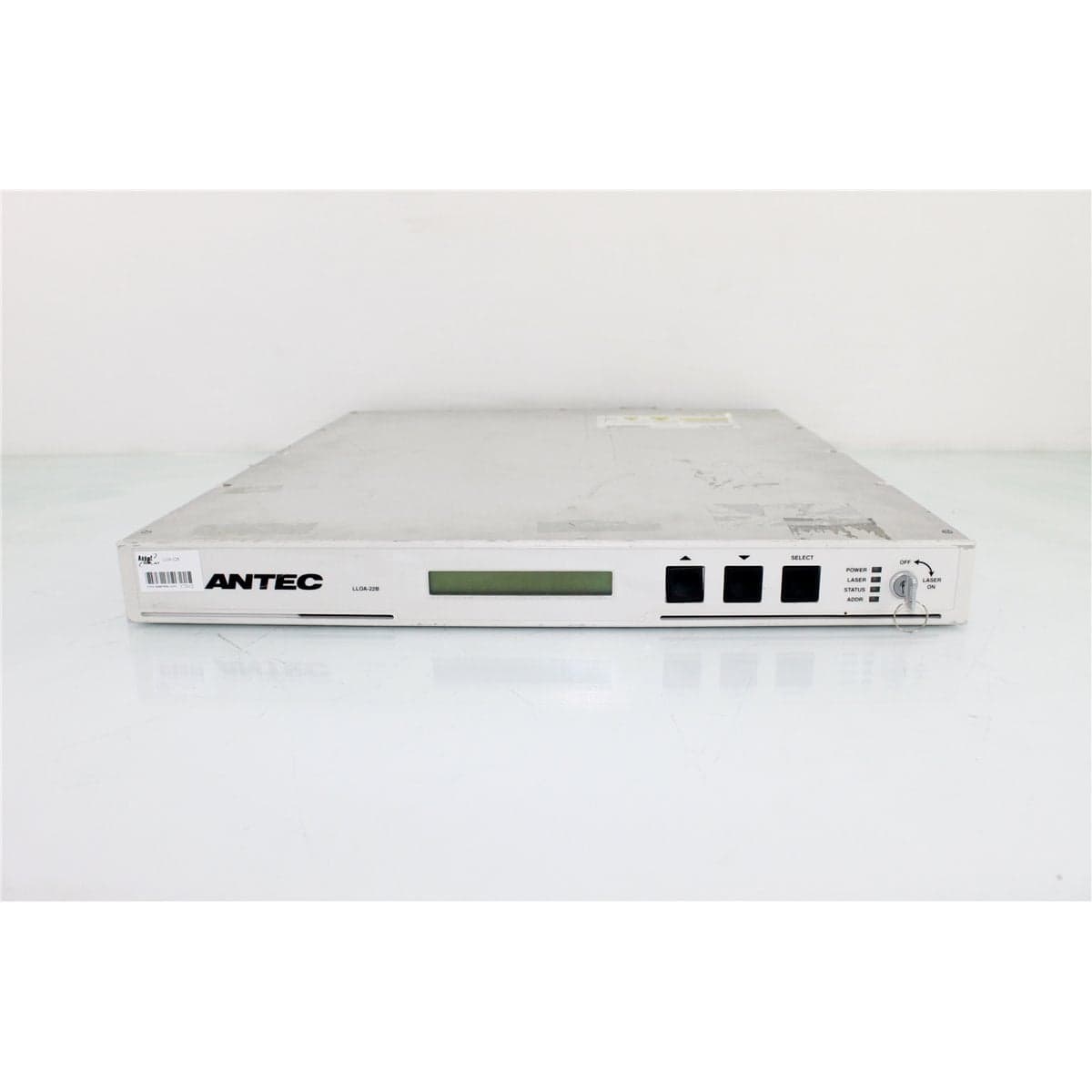
Antec · LLOA-22B
Antec LLOA-22B 22 dBm C-Band Erbium-Doped Fiber Amplifier
$3,032.00
Price in USD.
- Condition
- New (open box)
- Availability
- In stock
- Model
- LLOA-22B
- Manufacturer
- Antec
- Category
- C-Band EDFAs
Description
Antec LLOA-22B 22 dBm C-Band Erbium-Doped Fiber Amplifier
The Antec LLOA-22B is a C-band erbium-doped fiber amplifier designed to increase the power of compatible optical signals for telecommunications, fiber optic testing, laboratory research, and production applications. It belongs to the Laser Link optical amplifier series and can also be used as a fiber booster amplifier in supported optical systems.
The amplifier provides optical output power up to +22 dBm. This corresponds to approximately 158.5 mW of optical power, providing a substantial output level for compatible C-band transmission experiments, component characterization, receiver testing, loss-compensation applications, and laboratory test arrangements.
The documented minimum input power is -10 dBm. The front-panel controls allow the operator to adjust output power using variable optical attenuation, providing practical control over the amplified signal supplied to downstream equipment.
The LLOA-22B is housed in a standard 19-inch 1U rack-mount enclosure that can also be used as a benchtop instrument. This format supports integration into laboratory racks, automated test stations, optical communications equipment, and production systems where compact installation and convenient front-panel access are required.
Features and Benefits of the Antec LLOA-22B
The Antec LLOA-22B provides controlled C-band optical amplification for professional users working with fiber optic telecommunications and photonics systems.
- C-band optical amplification: Amplifies compatible optical signals within the telecommunications C-band.
- Up to +22 dBm output: Provides a maximum documented optical output equivalent to approximately 158.5 mW.
- Minimum -10 dBm input: Supports compatible optical input signals at levels down to the documented minimum.
- EDFA technology: Uses erbium-doped fiber amplification for compatible signals in the 1550 nm telecommunications region.
- Fiber booster operation: Can increase optical power before a transmission path, test assembly, or compatible downstream device.
- Front-panel output adjustment: Allows the operator to control output power using variable attenuation.
- 19-inch rack-mount format: Fits compatible laboratory and production equipment racks.
- Compact 1U enclosure: Minimizes rack-space requirements in optical test and communications systems.
- Benchtop capability: Can be incorporated into laboratory setups without permanent rack installation.
- Professional optical applications: Suitable for telecommunications research, optical component testing, laboratory experiments, and production workflows.
C-Band Erbium-Doped Fiber Amplification
The LLOA-22B uses erbium-doped fiber amplifier technology to increase optical signal power without first converting the signal into an electrical format. Optical pump energy excites erbium ions within the amplifier’s gain fiber, allowing compatible C-band signals to be amplified as they pass through the instrument.
This direct optical amplification method is widely useful in telecommunications and photonics systems where additional optical power is required to compensate for loss or provide a stronger signal for downstream testing.
Actual amplifier performance depends on the optical input wavelength, input power, output setting, amplifier condition, connector cleanliness, fiber routing, and operating environment. Applications requiring exact gain, bandwidth, noise figure, or spectral response should verify those values directly with appropriate calibrated equipment.
Up to +22 dBm Optical Output
The Antec LLOA-22B provides optical output power up to +22 dBm. An optical level of +22 dBm corresponds to approximately 158.5 mW.
This output can support test paths containing loss from patch cords, optical switches, couplers, filters, attenuators, connectors, and devices under test. The amplifier can also provide increased optical power for compatible transmission experiments and component evaluation.
The maximum output rating should not be interpreted as the output produced under every input condition. Available output depends on input wavelength, input power, current amplifier settings, internal control behavior, and whether the amplifier is operating below or near optical saturation.
A calibrated optical power meter should be used to verify the output before the amplifier is connected to sensitive equipment. External attenuation may be required to protect receivers, detectors, optical spectrum analyzers, and power meters with lower maximum input ratings.
Minimum -10 dBm Optical Input
The documented minimum input power is -10 dBm. This corresponds to 0.1 mW of optical input power.
The input signal should remain compatible with the amplifier’s C-band operating range and optical interface. Input signals below the documented minimum may not produce the expected output level or amplifier performance.
The maximum allowable input power is not included in the supplied information and should be verified before a high-power source is connected. Both the input and output levels should be monitored during initial setup.
Front-Panel Output-Power Adjustment
The LLOA-22B includes front-panel user controls for adjusting output power through variable optical attenuation. This allows the amplified output to be reduced according to the requirements of the connected test system or device under test.
Front-panel adjustment is useful when several optical power levels must be evaluated without changing the input source or installing a different external fixed attenuator for each measurement.
The current output should be verified with a calibrated power meter after adjustment. The front-panel setting alone should not be treated as a traceable measurement of the optical power delivered at the end of an external patch cord or test path.
Rack-Mount and Benchtop Integration
The amplifier uses a standard 19-inch 1U enclosure. This format supports installation in compatible laboratory, telecommunications, production, and equipment racks while conserving vertical rack space.
The instrument can also be used as a benchtop amplifier when installed on a stable surface with adequate ventilation and appropriate clearance for optical fibers, electrical cables, and operator access.
Ventilation openings should remain unobstructed. The amplifier should not be installed directly beside equipment that introduces excessive heat unless the rack or test station provides suitable airflow and temperature control.
Typical Applications
The Antec LLOA-22B is suitable for professional applications such as:
- C-band optical signal amplification
- Fiber optic telecommunications testing
- Optical transmission experiments
- Fiber booster amplifier applications
- Optical component characterization
- Receiver and detector testing
- Optical switch and attenuator evaluation
- Filter and coupler testing
- Laboratory photonics research
- Production and quality-control testing
- System-integration projects
- High-power C-band source requirements
Product Overview
| Brand | Antec |
| Model | LLOA-22B |
| Product Series | Laser Link Optical Amplifier Series |
| Product Category | C-Band Erbium-Doped Fiber Amplifier |
| Amplifier Application | Optical fiber booster amplifier |
| Maximum Output Power | Up to +22 dBm |
| Equivalent Maximum Output | Approximately 158.5 mW |
| Minimum Input Power | -10 dBm |
| Output Control | Front-panel variable attenuation |
| Mechanical Format | Standard 19-inch 1U rack-mount or benchtop instrument |
| Primary Application | Controlled C-band optical signal amplification |
Specifications
| Specification | Details |
| Manufacturer | Antec |
| Model Number | LLOA-22B |
| Amplifier Type | Erbium-doped fiber amplifier |
| Optical Band | C-band |
| Maximum Output Power | +22 dBm |
| Maximum Output in Milliwatts | Approximately 158.5 mW |
| Minimum Input Power | -10 dBm |
| Minimum Input in Milliwatts | 0.1 mW |
| Output-Power Adjustment | Front-panel variable optical attenuation |
| Chassis Format | 19-inch 1U rack-mount and benchtop configuration |
Configuration Details Requiring Verification
| Configuration Item | Verification Required |
| Exact Wavelength Range | Confirm the supported C-band operating bandwidth from the unit documentation or direct testing |
| Maximum Input Power | Verify before connecting a high-power optical source |
| Small-Signal Gain | Measure at the required wavelength and input-power level |
| Noise Figure | Confirm at the required wavelength, gain, and input-power conditions |
| Optical Connector Type | Confirm the connector family and ferrule polish installed on the input and output |
| Fiber Type | Confirm from the amplifier label and optical interface configuration |
| Control Modes | Confirm available operating modes, alarms, and output-control functions |
| Remote Interface | Confirm whether a serial, GPIB, Ethernet, or another communication interface is installed |
| AC Power Requirements | Verify the voltage, frequency, current rating, and power-cord requirements before operation |
Installation and Operation
The Antec LLOA-22B should be installed on a stable laboratory bench or in a compatible 19-inch equipment rack. Adequate clearance should be maintained for ventilation, optical patch cords, AC power, and control access.
The optical input and output ports should be identified before patch cords are connected. The source must connect to the amplifier input, while the downstream optical system or measurement instrument must connect to the amplifier output.
All optical connectors should be inspected and cleaned before mating. The connector family and ferrule polish of the patch cords must match the interfaces installed on the amplifier.
The input should begin at a conservative optical level. Output power should be set to a reduced value during initial setup and verified using a calibrated optical power meter before sensitive equipment is connected.
Connector Care and Optical Safety
The LLOA-22B can produce up to approximately 158.5 mW of invisible C-band optical power. The absence of visible light does not indicate that the amplifier output is disabled.
Users should not look into the optical output, patch cord, adapter, or exposed fiber end. The amplifier and connected source should be disabled before connectors are inspected, cleaned, attached, or removed.
A clean protective cap should remain installed on each unused optical port. Dirty or damaged caps should not be placed on cleaned connectors.
Comprehensive Functional and Performance Testing
The Antec LLOA-22B receives comprehensive functional and performance testing before shipment. Evaluation may include AC power operation, startup, front-panel controls, output adjustment, indicator operation, thermal stabilization, alarm status, and optical enable and disable functions.
Optical testing may include input-to-output continuity, C-band amplification, output-power verification up to the supported +22 dBm level, and representative gain measurements when compatible C-band sources and calibrated equipment are available.
The optical input and output connectors, front-panel controls, display or indicators, AC inlet, cooling openings, enclosure, model label, rack hardware, and safety markings may be inspected for contamination, damage, corrosion, unauthorized modification, or excessive wear.
The exact testing scope depends on the connector configuration, available C-band optical source, variable attenuator, calibrated power meter, optical spectrum analyzer, reference patch cords, and requested input and output test conditions.
Calibration Before Shipment
When technically applicable and selected, the Antec LLOA-22B can be calibrated or performance-verified before shipment. Evaluation may include output power, gain, wavelength response, gain flatness, noise figure, optical monitoring, output adjustment, and stability.
Calibration documentation should identify the amplifier model and serial number, optical connectors, test wavelengths, input power, output setting, measured output power, gain, reference patch cords, measurement instruments, environmental conditions, recorded results, and applicable measurement uncertainty.
Buyers requiring formal calibration should specify the required wavelengths, input-power points, output-power levels, gain measurements, noise-figure testing, certificate format, recorded results, and required measurement uncertainty before purchase.
Why Buy from AssetRelay?
AssetRelay supplies professional equipment and product solutions for fiber optic, telecommunications, optical testing, photonics, laboratory, production, inspection, electronic testing, RF/microwave, and technical research applications. The Antec LLOA-22B provides high-power C-band amplification for telecommunications laboratories, optical component manufacturers, production facilities, system integrators, universities, and photonics research organizations.
Buyers should review the +22 dBm output capability, -10 dBm minimum input, front-panel variable attenuation, connector configuration, optical interface condition, rack-mount format, functional test results, calibration status, and included accessories before purchase.