
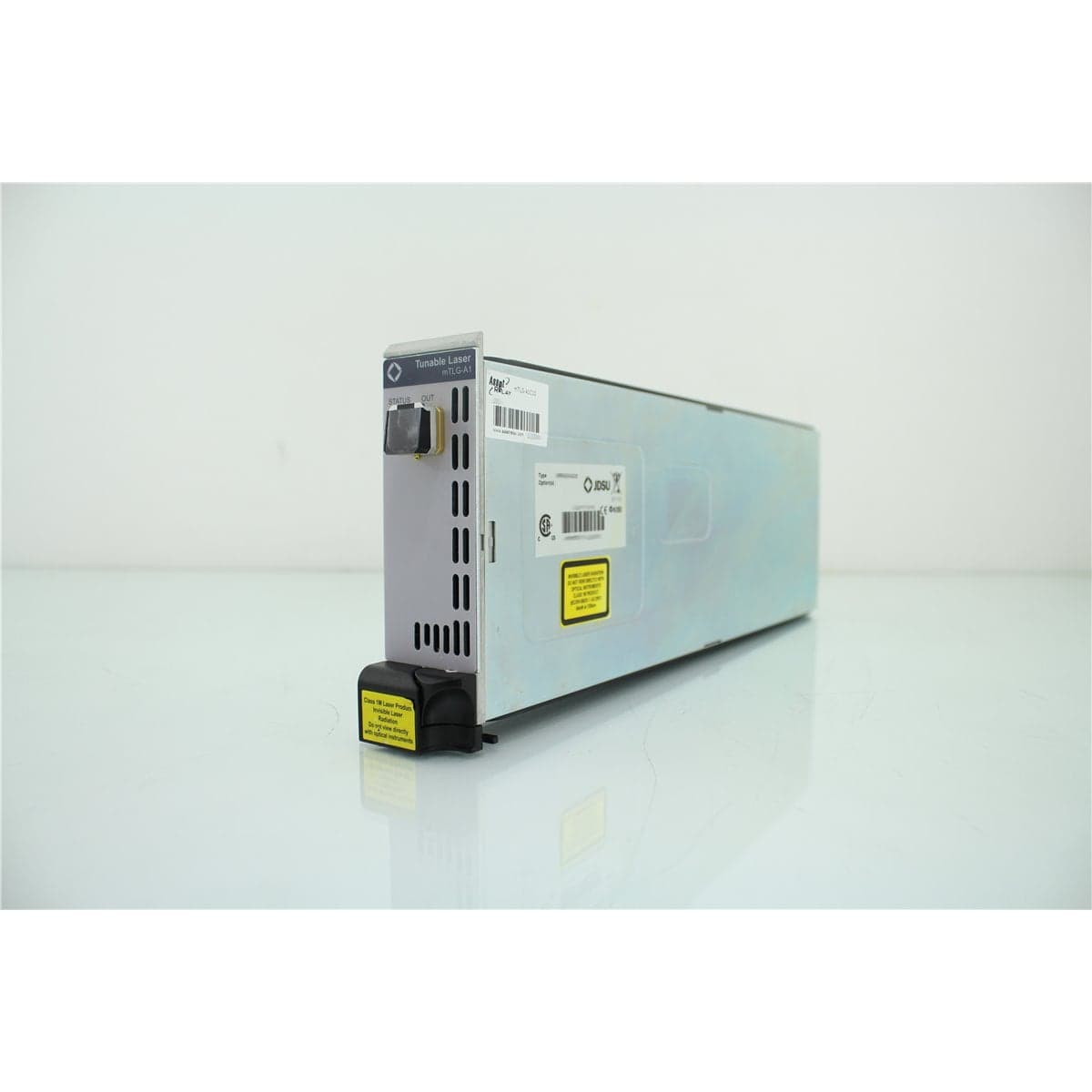
JDS · mTLG-A1C10
JDS JDSU mTLG-A1C10 C-Band Single Laser Source
$3,198.40
Price in USD.
- Condition
- New (open box)
- Availability
- In stock · 2 available
- Model
- mTLG-A1C10
- Manufacturer
- JDS
- Category
- Tunable Laser Sources
Description
JDSU mTLG-A1C10 MAP C-Band Single Tunable DBR Laser Module
The JDSU mTLG-A1C10 is a single-channel C-band tunable Distributed Bragg Reflector laser module designed for the JDSU MAP-200 Multiple Application Platform. It provides wavelength-selectable optical output for DWDM testing, optical amplifier evaluation, fiber characterization, transmitter and receiver testing, and general photonics research or production applications.
The mTLG-A1C10 covers frequencies from 191.30 THz to 196.10 THz, corresponding to wavelengths from 1528.77 nm to 1567.13 nm. Its 25 GHz channel spacing supports precise selection across the C-band grid, while the 7 dBm to 13 dBm optical power-setting range allows the output level to be adjusted for different test requirements.
The module is based on a Sampled Grating Distributed Bragg Reflector laser with an integrated wavelength locker. An automatic power-control loop and wavelength-locking system support stable wavelength and output-power performance. Wavelength and power settings are controlled through the MAP-200 local interface or compatible automation interfaces.
Features and Benefits of the JDSU mTLG-A1C10
The JDSU mTLG-A1C10 provides precise, configurable optical output for engineers, laboratories, production facilities, and service organizations working with C-band DWDM components and communication systems.
- Single-channel C-band configuration: Provides one independently controlled tunable laser within the MAP module.
- Wide C-band tuning range: Covers 191.30 THz to 196.10 THz, equivalent to 1528.77 nm to 1567.13 nm.
- 25 GHz channel spacing: Supports fine wavelength selection for dense wavelength-division multiplexing applications.
- Adjustable output power: Provides a setting range from 7 dBm to 13 dBm.
- High maximum output: Delivers more than 12 dBm at the maximum C-band power setting.
- Narrow linewidth: Provides a natural instantaneous linewidth of 5 MHz or less.
- High side-mode suppression: Provides SMSR of at least 40 dB, with typical performance of 45 dB.
- Integrated wavelength locker: Supports stable operation and accurate on-demand wavelength selection.
- Automatic power control: Helps maintain stable optical output during laboratory and production measurements.
- Polarization-maintaining fiber: Uses PM fiber with polarization aligned to the slow axis and connector.
- FC/APC optical interface: Supports compatible angled-contact, polarization-maintaining optical connections.
- MAP-200 integration: Provides local and automated control through the compatible Multiple Application Platform.
C-Band Tunable Wavelength Operation
The JDSU mTLG-A1C10 provides wavelength tuning across a range of approximately 38 nm. Its frequency range extends from 191.30 THz to 196.10 THz, corresponding to wavelengths from 1528.77 nm to 1567.13 nm.
The module supports 25 GHz channel spacing, allowing users to select closely spaced optical channels for DWDM component and transmission-system testing. This capability is useful when evaluating filters, multiplexers, demultiplexers, wavelength-selective switches, optical amplifiers, receivers, and other wavelength-dependent devices.
Specified wavelength accuracy is ±2 GHz, equivalent to approximately ±0.016 nm. Typical wavelength stability is ±0.005 nm over 15 minutes and ±0.01 nm over 24 hours under the stated operating conditions.
Adjustable Optical Output Power
The mTLG-A1C10 provides a C-band optical power setting range from 7 dBm to 13 dBm. At the maximum setting, the output power is greater than 12 dBm. This adjustable range allows the source to support optical component characterization at different launch levels.
Typical power-setting resolution is better than 0.1 dB. Typical output-power stability is ±0.005 dB over 15 minutes and ±0.03 dB over 24 hours under the specified conditions.
The combination of adjustable power and wavelength control can reduce the need for separate fixed-wavelength sources in tests requiring multiple C-band channels. An external optical attenuator may still be required when the device under test needs power below the module’s minimum 7 dBm setting.
Narrow-Linewidth SGDBR Laser Technology
The mTLG-A1C10 is based on a Sampled Grating Distributed Bragg Reflector laser. This tunable laser architecture supports electronic wavelength selection across the C-band while maintaining a narrow optical spectrum.
The natural instantaneous linewidth is specified at 5 MHz or less. With self-homodyne measurement methods, the indicated linewidth is typically between 50 MHz and 100 MHz. The measurement method should therefore be considered when comparing linewidth values or integrating the module into a specific optical experiment.
The C-band side-mode suppression ratio is at least 40 dB, with typical performance of 45 dB. Relative intensity noise is typically -140 dB/Hz, with a stated maximum of -135 dB/Hz.
Integrated Wavelength and Power Stabilization
An integrated wavelength locker helps maintain the selected optical channel during operation. This function is especially valuable in DWDM measurements where small wavelength changes can affect insertion loss, channel isolation, passband response, and other device characteristics.
The automatic power-control loop helps maintain the selected output level. Together, the wavelength locker and power-control system support stable measurements during wavelength sweeps, long-term component evaluation, automated production sequences, and repeated device testing.
The specified wavelength and power stability values apply at full power after a one-hour warm-up and at a constant temperature within 25 °C ±3 °C.
Typical Applications
The JDSU mTLG-A1C10 C-Band Tunable Laser Module is suitable for professional applications such as:
- DWDM transmission-system testing
- Optical amplifier testing
- EDFA gain and spectral-response evaluation
- Tunable laser-grid generation
- Optical filter characterization
- MUX and DEMUX testing
- Wavelength-selective component evaluation
- Fiber characterization
- Transmitter and receiver testing
- Photonics research and development
- Production testing and quality control
- Automated C-band optical measurement systems
Product Overview
| Brand | JDSU / JDS Uniphase |
| Model | mTLG-A1C10 |
| Product Family | MAP Tunable DBR Laser, mTLG-A1 Series |
| Product Category | C-Band Tunable Laser Module |
| Channel Configuration | Single laser |
| Optical Band | C-band |
| Laser Technology | Sampled Grating Distributed Bragg Reflector laser |
| Compatible Platform | JDSU MAP-200 Multiple Application Platform |
| Optical Connector | FC/APC |
| Primary Application | Tunable C-band optical source for DWDM and photonics testing |
Wavelength Specifications
| Specification | JDSU mTLG-A1C10 Details |
| Frequency Tuning Range | 191.30 THz to 196.10 THz |
| Wavelength Tuning Range | 1528.77 nm to 1567.13 nm |
| Approximate Tuning Span | 38 nm |
| Wavelength Accuracy | ±2 GHz, equivalent to approximately ±0.016 nm |
| Typical Wavelength Stability, 15 Minutes | ±0.005 nm |
| Typical Wavelength Stability, 24 Hours | ±0.01 nm |
| Channel Spacing | 25 GHz |
Optical Power Specifications
| Specification | C-Band Details |
| Power Setting Range | 7 dBm to 13 dBm |
| Output Power at Maximum Setting | Greater than 12 dBm |
| Typical Power Stability, 15 Minutes | ±0.005 dB |
| Typical Power Stability, 24 Hours | ±0.03 dB |
| Typical Power Resolution | Better than 0.1 dB |
Spectral Specifications
| Specification | JDSU mTLG-A1C10 Details |
| Natural Instantaneous Linewidth | 5 MHz or less |
| Self-Homodyne Indicated Linewidth | Typically 50 MHz to 100 MHz |
| Side-Mode Suppression Ratio | 40 dB minimum, 45 dB typical |
| Relative Intensity Noise | -140 dB/Hz typical, -135 dB/Hz maximum |
Fiber, Connector, and Physical Specifications
| Specification | Details |
| Fiber Type | Polarization-maintaining fiber |
| Polarization Alignment | Aligned to the slow axis and connector |
| Supported Connector | FC/APC |
| Warm-Up Time | One hour |
| Operating Temperature | 10 °C to 40 °C |
| Humidity | Less than 80% relative humidity from 10 °C to 40 °C, non-condensing |
| Dimensions | 4.06 cm x 13.26 cm x 37.03 cm |
| Dimensions, Imperial | 1.6 inches x 5.22 inches x 14.58 inches |
| Maximum Weight | 1.3 kg (2.95 lb), varying by configuration |
MAP-200 Platform Integration
The JDSU mTLG-A1C10 requires a compatible MAP-200 chassis for power, local operation, wavelength control, output-power settings, and automation access. The module does not function as a standalone tunable laser.
The MAP-200 platform supports Ethernet-based connectivity and interchangeable virtual instrument drivers for integration into automated optical test environments. The platform’s modular design allows compatible optical sources, power meters, attenuators, switches, and other instruments to be assembled into an application-specific system.
Buyers should verify MAP-200 chassis compatibility, available module capacity, controller firmware, software support, automation interfaces, and the condition of the chassis module connectors before purchase.
Measurement Preparation and Optical Interface Care
The mTLG-A1C10 should complete its one-hour warm-up period before precision wavelength, power, and stability measurements. The required wavelength and power level should be configured before connecting a sensitive device under test.
The FC/APC connector and polarization-maintaining patch cable should be inspected and cleaned before connection. Contaminated or damaged interfaces can increase insertion loss, reduce return loss, create instability, and affect polarization alignment.
The PM patch cable should be compatible with the connector key and slow-axis alignment used by the module. Fiber routing should provide suitable bend-radius control and strain relief to protect optical performance.
Laser Safety and Compliance
When installed in a compatible MAP chassis, the MAP Tunable DBR Laser is identified as meeting the requirements of Class 1M under IEC 60825-1. The platform also supports the stated CE, CSA, UL, IEC 61010-1, and LXI Class C requirements.
Users should never view the optical output directly or through optical instruments. The output should remain properly capped or connected to a compatible optical path whenever the laser is enabled.
Laser safety, electrical safety, chassis installation, and servicing procedures should follow the applicable MAP-200 operating instructions and laboratory safety requirements.
Calibration and Testing Before Shipment
When calibration is technically applicable and supported, the JDSU mTLG-A1C10 is calibrated before shipment. The calibration process may include verification of wavelength accuracy, wavelength stability, optical output power, power stability, channel selection, spectral performance, and operation of the integrated wavelength-locking and power-control functions.
Following successful calibration, the module may include a calibration label, calibration certificate, and related calibration data, depending on the equipment configuration and calibration service.
If formal calibration is unavailable or not applicable to the specific module, the unit receives comprehensive functional and performance testing. This process may include compatible-chassis recognition, wavelength tuning across the available C-band range, optical output verification, power adjustment, wavelength-locker operation, output stability, FC/APC connector inspection, and automation-interface control.
This testing helps verify that the equipment operates correctly and that its available functions have been evaluated before it is released for shipment. The exact calibration scope, documentation, test data, and service records should be confirmed before purchase when these items are required for laboratory, production, regulatory, or quality-management applications.
Buyer Considerations
The JDSU mTLG-A1C10 is specifically the C-band single-laser configuration. Buyers should confirm that the 1528.77 nm to 1567.13 nm wavelength range, 25 GHz channel spacing, 7 dBm to 13 dBm power-setting range, FC/APC connector, and polarization-maintaining fiber match the intended application.
The mTLG-A1C10 should not be confused with the mTLG-A1C20 dual-density module, mTLG-A1C40 quad-density module, or corresponding L-band configurations. Each product code identifies a specific wavelength band and channel density.
Buyers should review the module condition, optical connector condition, chassis compatibility, calibration status, firmware support, and included accessories. A compatible MAP-200 chassis, PM FC/APC patch cables, automation software, and measurement equipment may be required separately.
Why Buy from AssetRelay?
AssetRelay supplies professional equipment and product solutions for fiber optic, telecom, laboratory, production, inspection, cleaning, RF/microwave, electronic test, and photonics applications. The JDSU mTLG-A1C10 is listed to help engineers, laboratory personnel, production facilities, procurement teams, and service organizations source tunable C-band laser equipment for professional optical test systems.
Buyers should review the available product photographs, physical condition, optical connector condition, included accessories, calibration information, and MAP-200 compatibility before purchase. Confirming these details helps ensure that the module matches the intended wavelength range, channel spacing, optical power, polarization requirements, and automated test workflow.
Only accessories specifically identified in the product listing should be considered included. The MAP-200 chassis, controller, PM FC/APC patch cables, optical attenuators, power sensors, software, and automation accessories may be required separately.