
JDS · HA9-Z035
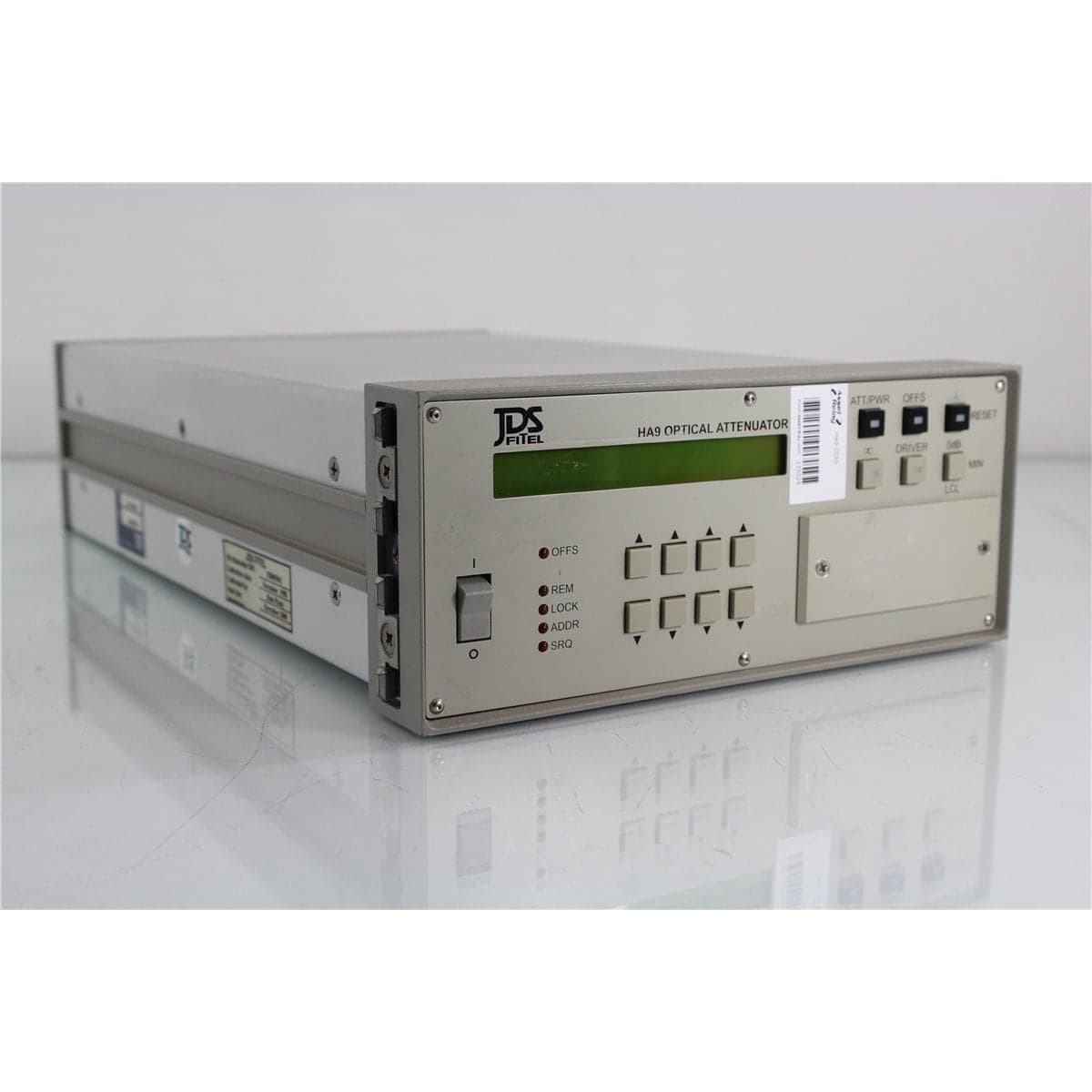
JDS FITEL HA9-Z035 100 dB Single-Mode 9/125 µm Variable Optical Attenuator
$4,619.20
Price in USD.
- Condition
- Used
- Availability
- In stock · 2 available
- Model
- HA9-Z035
- Manufacturer
- JDS
- Category
- Optical Attenuators 62.5-125
Description
JDS FITEL HA9-Z035 Single-Mode Variable Optical Attenuator
The JDS FITEL HA9-Z035 is a programmable variable optical attenuator configured for 9/125 µm single-mode fiber. It is designed for precise optical signal-level control in telecommunications, fiber optic component testing, receiver evaluation, calibration, laboratory automation, and production applications.
The HA9 platform provides attenuation from 0 dB to 100 dB across wavelengths from 1200 nm to 1700 nm. Attenuation can be set with 0.01 dB resolution at 1300 nm, allowing controlled adjustment of optical power over a broad dynamic range.
A built-in optical on/off switch provides more than 110 dB of isolation and operates in less than 20 milliseconds. This function allows the optical signal to be interrupted without changing the programmed attenuation setting or switching off the connected optical source.
The complete HA9-Z035 suffix represents a factory-defined configuration. The supplied product identification establishes 9/125 µm single-mode fiber. The installed optical connector type, front-panel port style, backreflection configuration, and optional switch or splitter should be verified from the physical instrument before compatible accessories are selected.
Features and Benefits of the JDS FITEL HA9-Z035
- Single-mode fiber configuration: Designed for compatible 9/125 µm fiber optic systems.
- Wide attenuation range: Provides programmable attenuation from 0 dB to 100 dB.
- Broad wavelength coverage: Supports compatible optical signals from 1200 nm to 1700 nm.
- Fine attenuation adjustment: Provides 0.01 dB setting resolution at 1300 nm.
- Accurate attenuation control: Supports precise optical-level adjustment for receiver and component testing.
- High repeatability: Provides ±0.015 dB attenuation repeatability at constant temperature and wavelength.
- Low insertion loss: The single-mode HA9 configuration provides insertion loss of 2.0 dB or less, excluding external connectors and any installed switch or coupler.
- Low polarization sensitivity: Provides less than 0.1 dB peak-to-peak polarization sensitivity across the attenuation range.
- High optical input capability: Supports optical input power up to 200 mW.
- Integrated optical shutter: Provides more than 110 dB of optical isolation.
- Fast shutter response: Switches the optical path in less than 20 milliseconds.
- Automated test integration: Suitable for programmable laboratory and production measurement systems.
0 dB to 100 dB Attenuation Range
The JDS FITEL HA9-Z035 provides an attenuation range from 0 dB to 100 dB throughout its documented 1200 nm to 1700 nm wavelength range. This broad range allows the instrument to simulate both low-loss and high-loss optical paths without requiring repeated changes to fixed attenuators.
High attenuation settings are useful for receiver sensitivity testing, weak-signal simulation, optical detector characterization, link-budget evaluation, and measurements requiring very low received power.
The attenuator can move from 0 dB to 100 dB in 2.5 seconds or less. This supports automated optical-level sweeps and production tests that require several power settings.
9/125 µm Single-Mode Fiber
The HA9-Z035 is configured for 9/125 µm single-mode fiber. Compatible single-mode patch cords, optical sources, receivers, detectors, switches, and devices under test should be used throughout the measurement path.
Maintaining single-mode fiber helps preserve the intended optical launch condition and supports repeatable attenuation measurements. Multimode patch cords should not be substituted when controlled single-mode performance is required.
Patch cords should be protected from excessive bending, pulling, twisting, crushing, and repeated movement. Mechanical changes in the fiber path can affect optical power and measurement repeatability.
Attenuation Accuracy and Repeatability
Within the documented 1280 nm to 1340 nm and 1470 nm to 1550 nm regions, attenuation accuracy is specified at ±0.1 dB or ±0.004 dB per decibel of attenuation, whichever value is greater.
Attenuation repeatability is specified at ±0.015 dB under constant temperature and wavelength conditions. High repeatability is valuable for receiver testing, component qualification, calibration workflows, and automated measurements that revisit the same attenuation settings.
Complete system accuracy also depends on source stability, wavelength accuracy, connector cleanliness, fiber condition, external optical loss, and the performance of the optical power meter used to verify the signal.
0.01 dB Setting Resolution
The attenuator provides 0.01 dB setting resolution at 1300 nm. This fine adjustment allows small and controlled changes to the optical level reaching a device under test.
The setting increment should not be interpreted as total measurement uncertainty. Actual optical power at the output also depends on attenuation accuracy, insertion loss, source stability, connector condition, external components, and the measurement reference plane.
Low Insertion Loss
The documented insertion loss for the single-mode HA9 configuration is 2.0 dB or less. This value excludes losses from external connectors and any optional switch or coupler installed in the optical path.
Low insertion loss helps preserve the available source power and usable measurement range, particularly in test systems containing several patch cords, switches, couplers, adapters, and passive optical components.
Built-In Optical Shutter
The HA9 includes a built-in optical on/off switch providing more than 110 dB of isolation. The shutter can interrupt the optical signal without changing the programmed attenuation value.
Shutter switching time is documented at less than 20 milliseconds. This fast response supports dark measurements, receiver protection, automated test sequences, and rapid transitions between signal-on and signal-off conditions.
The optical shutter does not replace normal laser-safety procedures. The source should still be disabled before connectors are inspected, cleaned, attached, or removed.
Optional Optical Configurations
The HA9 Series was available with several factory options. A 1 x 2 optical switch could be installed in addition to the standard on/off shutter, allowing selection between two inputs or outputs.
Optional 50/50 and 10/90 optical splitters were also available. Low-backreflection and specialized analog configurations were offered for selected HA9 models.
These functions should only be included in the product configuration when the corresponding hardware or complete option code is verified on the individual instrument.
Typical Applications
- Single-mode optical receiver sensitivity testing
- Controlled optical loss simulation
- Fiber optic component characterization
- Optical detector testing
- Transceiver evaluation
- Insertion loss and transmission measurements
- Optical power meter linearity testing
- Optical amplifier test systems
- Automated optical-level sweeps
- Laboratory instrument calibration
- Production screening and quality assurance
- Telecommunications research and development
Product Overview
| Brand | JDS FITEL |
| Model | HA9-Z035 |
| Product Series | HA9 Series |
| Product Category | Programmable Variable Optical Attenuator |
| Fiber Type | 9/125 µm single-mode fiber |
| Wavelength Range | 1200 nm to 1700 nm |
| Attenuation Range | 0 dB to 100 dB |
| Attenuation Setting Resolution | 0.01 dB at 1300 nm |
| Optical Shutter | Built-in on/off switch with more than 110 dB isolation |
| Primary Application | Precise single-mode optical signal-level control and loss simulation |
Optical Specifications
| Specification | Details |
| Fiber Configuration | 9/125 µm single-mode fiber |
| Wavelength Range | 1200 nm to 1700 nm |
| Attenuation Range | 0 dB to 100 dB |
| Attenuation Settability at 1300 nm | 0.01 dB |
| Attenuation Accuracy from 1280 nm to 1340 nm | ±0.1 dB or ±0.004 dB per dB, whichever is greater |
| Attenuation Accuracy from 1470 nm to 1550 nm | ±0.1 dB or ±0.004 dB per dB, whichever is greater |
| Attenuation Repeatability | ±0.015 dB at constant temperature and wavelength |
| Maximum Insertion Loss | 2.0 dB, excluding connectors, switch, or coupler when installed |
| Maximum Optical Input Power | 200 mW |
| Polarization Sensitivity | Less than 0.1 dB peak-to-peak across the attenuation range |
| Attenuation Change Time | 2.5 seconds or less from 0 dB to 100 dB |
| Optical Shutter Isolation | Greater than 110 dB |
| Optical Shutter Speed | Less than 20 ms |
| Recalibration Period | Not required in the supplied HA9 specifications |
Backreflection Configurations
| Configuration | Documented Single-Mode Backreflection |
| Low-Backreflection Configuration | Less than -45 dB, excluding connectors |
| Analog Configuration | Less than -60 dB, excluding connectors |
Available Connector Configurations
| Connector Code | Connector Type |
| NO | No connector |
| FC | FC |
| FP | FC/PC |
| FA | FC/APC |
| BC | Biconic |
| ST | ST |
| SP | ST/PC |
| D4 | D4 |
Environmental and Physical Specifications
| Specification | Details |
| Operating Temperature | 0 °C to 40 °C |
| Storage Temperature | -40 °C to +60 °C |
| Humidity | Up to 95% relative humidity at 40 °C, decreasing by 5% per °C from 40 °C to 60 °C |
| Dimensions | 35.5 x 21.2 x 8.9 cm |
| Weight | 3.75 kg |
Configuration Verification
The physical model label should be retained as HA9-Z035. The supplied product identification establishes a 9/125 µm single-mode configuration.
The exact optical connector, front-panel port arrangement, pigtail or bulkhead configuration, backreflection class, and installed switch or splitter option should be confirmed directly from the individual instrument.
A 1 x 2 optical switch, 50/50 splitter, 10/90 splitter, and specialized analog configuration were available within the HA9 family. These options should not be assigned unless the corresponding hardware or model code is verified.
Measurement Setup
The HA9-Z035 should be installed on a stable laboratory bench or in suitable test equipment with adequate clearance for ventilation, optical cables, communication cables, and AC power.
Compatible 9/125 µm single-mode patch cords should be connected to the optical input and output. The connector family and ferrule polish must match the interfaces installed on the individual attenuator.
All optical connectors should be inspected and cleaned before mating. When connecting a sensitive receiver or detector, the attenuator should initially be set to a high attenuation value.
The attenuation can then be reduced gradually while the optical output and device response are monitored. The optical input must remain below the documented 200 mW limit.
Comprehensive Functional and Performance Testing
The JDS FITEL HA9-Z035 is comprehensively tested before shipment. Evaluation may include AC power operation, startup, front-panel controls, display response, attenuation adjustment, optical shutter operation, and applicable remote communication functions.
Optical testing may include input-to-output continuity, insertion loss, representative attenuation settings, attenuation repeatability, attenuation range, response time, and on/off isolation using compatible single-mode sources and calibrated optical power meters.
The optical interfaces, pigtails or bulkheads, connectors, shutter, front-panel controls, display, communication ports, AC inlet, enclosure, labels, and installed options may be inspected for contamination, damage, corrosion, or excessive wear.
The exact testing scope depends on the verified connector type, port arrangement, installed options, available single-mode sources, reference patch cords, optical power meters, and requested wavelengths and attenuation values.
Why Buy from AssetRelay?
AssetRelay supplies professional equipment and product solutions for fiber optic, telecommunications, optical testing, photonics, laboratory, production, inspection, electronic testing, RF/microwave, and technical research applications. The JDS FITEL HA9-Z035 provides controlled single-mode optical attenuation for component manufacturers, receiver developers, telecommunications laboratories, production facilities, system integrators, universities, and research organizations.
Buyers should review the 9/125 µm single-mode configuration, wavelength and attenuation ranges, optical interfaces, insertion loss, shutter operation, installed options, functional test results, and included accessories before purchase.