
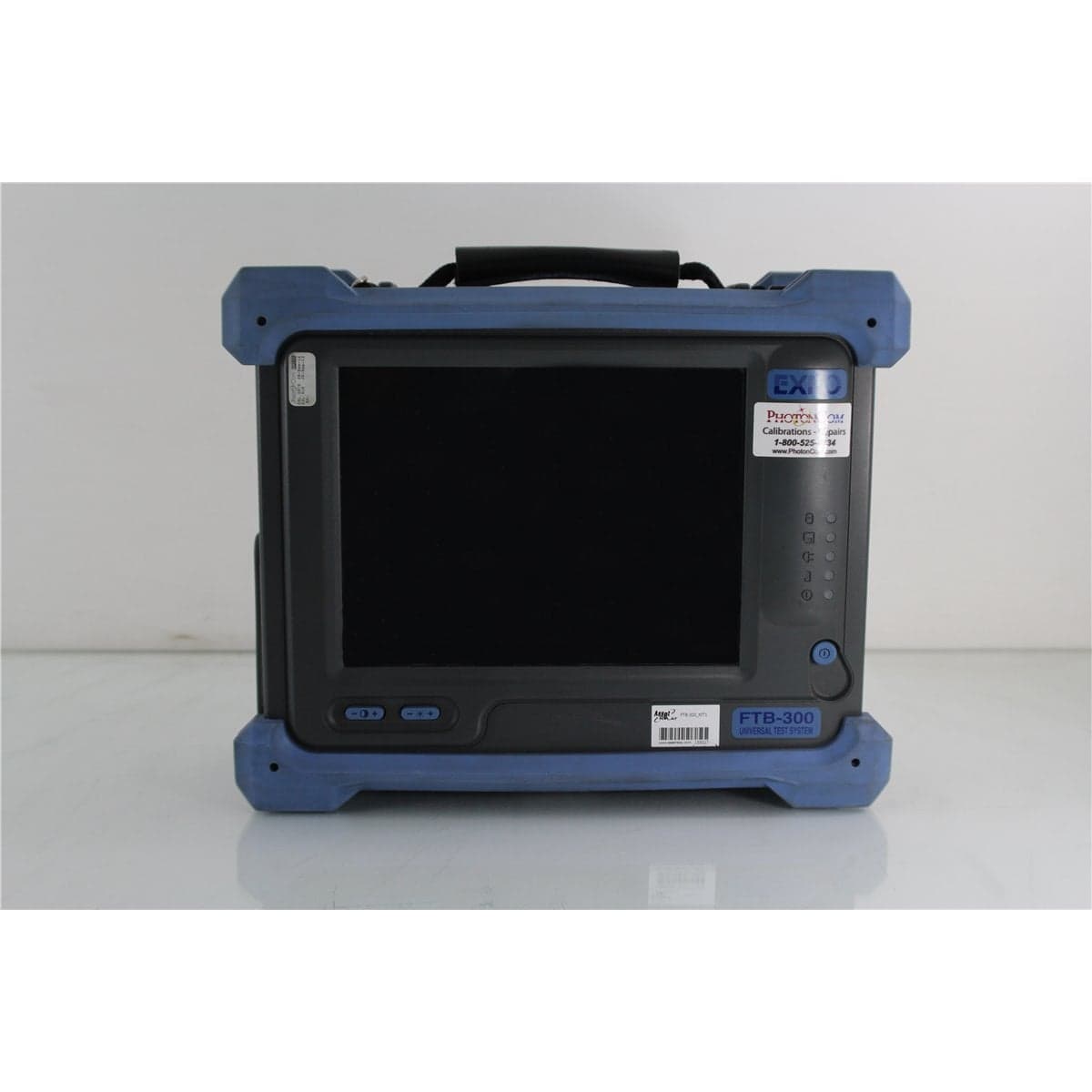
Exfo · FTB-300_KIT1
EXFO FTB-300 OTDR Module with 1300 nm Multimode and 1310/1550 nm Single-Mode Testing
$3,787.20
Price in USD.
- Condition
- Used
- Availability
- In stock
- Model
- FTB-300_KIT1
- Manufacturer
- Exfo
- Category
- Mainframes
Description
EXFO FTB-300 Triple-Wavelength OTDR Module
The EXFO FTB-300 triple-wavelength OTDR module combines 1300 nm multimode testing with 1310 nm and 1550 nm single-mode testing. Designed for installation in the EXFO FTB-300 Universal Test System, the module provides a practical solution for technicians who work with both multimode premises cabling and single-mode telecommunications networks.
The module uses optical time domain reflectometry to detect, locate, and analyze events along a fiber link. It can help identify splices, connectors, breaks, reflective faults, localized losses, and other changes in the optical path. It also supports fiber length measurement, attenuation analysis, and evaluation of the overall link-loss budget.
The multimode and single-mode channels are integrated into one field-interchangeable module, reducing the need to carry separate OTDR instruments for different fiber types. Measurement control, trace display, event analysis, data storage, and reporting are provided by the compatible FTB-300 platform and installed EXFO ToolBox software.
Features and Benefits of the EXFO FTB-300 Triple-Wavelength OTDR Module
- Three test wavelengths: Combines 1300 nm multimode measurement with 1310 nm and 1550 nm single-mode OTDR testing.
- Multimode and single-mode capability: Supports fiber testing across premises, campus, access, metropolitan, and telecommunications networks.
- Fiber event location: Helps locate splices, connectors, breaks, reflective faults, bends, and other events along an optical link.
- Link-loss analysis: Supports evaluation of event loss, section attenuation, fiber length, and the overall optical loss budget.
- Dual-wavelength single-mode testing: Allows comparison of 1310 nm and 1550 nm traces to help identify wavelength-dependent losses.
- Field-interchangeable design: Installs in a compatible FTB-300 platform and can be exchanged as field-testing requirements change.
- Automatic analysis support: Works with compatible EXFO software for automatic event detection and trace analysis.
- Portable test solution: Uses the battery-powered FTB-300 platform for outside-plant, central-office, campus, and field-service applications.
- Integrated data storage: Uses the FTB-300 hard drive and optional removable media for saving traces and test results.
- Professional reporting: Supports compatible EXFO reporting tools for documenting fiber traces, events, settings, and project information.
1300 nm Multimode Fiber Testing
The 1300 nm OTDR channel is intended for compatible multimode fiber. This wavelength supports testing of premises cabling, campus networks, local-area network infrastructure, equipment interconnections, and other multimode fiber installations.
Measurements at 1300 nm can help locate physical connections, splices, breaks, bends, and reflective events. The OTDR trace can also be used to determine fiber length and evaluate the loss of individual events or sections of the link.
Reliable multimode OTDR measurements require suitable launch conditions. Fiber core size, numerical aperture, launch cable, connector type, and mode conditioning can influence the displayed trace and measured loss. The complete test configuration should match the multimode fiber under evaluation.
1310 nm Single-Mode Fiber Testing
The 1310 nm channel supports OTDR testing of compatible single-mode fiber links. This wavelength is widely used for installation, commissioning, and maintenance of telecommunications and outside-plant networks.
A 1310 nm trace can identify reflective and non-reflective events, measure link length, evaluate splice performance, and help establish a baseline record for the installed fiber. It is suitable for access networks, metropolitan links, central-office connections, fiber backbones, and other single-mode systems.
A suitable launch fiber can move the first connection beyond the OTDR dead zone and support measurement of the near-end connector. A receive fiber can be added when the far-end connection and complete link loss must also be evaluated.
1550 nm Single-Mode Fiber Testing
The 1550 nm channel provides a second wavelength for single-mode fiber characterization. Single-mode fiber generally exhibits lower attenuation near 1550 nm, making this wavelength useful for long links and systems with substantial cumulative loss.
Testing at 1550 nm can also help identify bends and stressed fiber sections that may produce greater attenuation than they do at 1310 nm. Comparing traces from both wavelengths provides a more complete view of the installed link.
For useful comparison, the 1310 nm and 1550 nm traces should be acquired using consistent launch and receive fibers, connector arrangements, index-of-refraction settings, and event-analysis methods whenever practical.
OTDR Event Detection and Analysis
The OTDR module measures returned backscatter and reflected light as a function of distance. The resulting trace represents the optical characteristics of the fiber and the events located along it.
Reflective events may include mechanical connections, open fiber ends, damaged connectors, and other interfaces containing an air gap or strong index change. Non-reflective events may include fusion splices, bends, and localized attenuation.
Compatible automatic analysis software can locate events and organize measurement results in an event table. Manual marker functions can be used to review specific sections, measure distance between points, and evaluate loss where automatic analysis requires additional interpretation.
Dual-Wavelength Single-Mode Analysis
Testing at both 1310 nm and 1550 nm provides more diagnostic information than a single-wavelength measurement. Connector and splice events may exhibit similar behavior at both wavelengths, while bends and stressed fiber can produce greater loss at 1550 nm.
Dual-wavelength results can help technicians differentiate normal connection loss from wavelength-sensitive attenuation. The two traces can also provide baseline documentation for future maintenance and comparison.
EXFO FTB-300 Platform Integration
The module requires a compatible EXFO FTB-300 Universal Test System. The FTB-300 can accommodate up to three field-interchangeable modules and provides the processing, display, controls, storage, software, and power required for operation.
The FTB-300 uses a PC-based architecture with the Windows 95 operating system. EXFO ToolBox 5 provides a common interface for compatible OTDR, optical power, optical switch, optical spectrum, polarization mode dispersion, and other test modules.
The touchscreen interface allows users to select measurement settings, position markers, review events, save traces, and prepare reports directly from the platform. Available external interfaces support compatible printers, VGA monitors, keyboards, mice, and communications equipment.
Trace Storage and Reporting
The FTB-300 platform includes an internal hard disk for storing test results. Depending on its configuration, the platform may also include a 3.5-inch floppy drive and a PCMCIA interface for compatible memory or communications cards.
ToolBox software supports functions such as rapid saving, printing, stored-trace preview, batch processing, and test-result management. These capabilities help technicians organize results from individual fibers and larger multi-fiber cable projects.
Compatible reporting tools can produce documents containing OTDR traces, event tables, measurement settings, cable information, operator comments, and project details. Available report functions depend on the installed software version and platform configuration.
Typical Applications
- 1300 nm multimode fiber testing
- 1310 nm and 1550 nm single-mode fiber testing
- Premises and campus network installation
- Telecom access and outside-plant testing
- Fiber length and attenuation measurement
- Splice-loss and connector-loss analysis
- Fiber break and fault location
- Wavelength-dependent bend detection
- Network installation and acceptance testing
- Preventive maintenance and troubleshooting
- Fiber baseline documentation
- Laboratory and production fiber analysis
Product Overview
| Brand | EXFO |
| Product Family | FTB-300 Universal Test System |
| Product Category | Triple-Wavelength Multimode and Single-Mode OTDR Module |
| Multimode Wavelength | 1300 nm |
| Single-Mode Wavelengths | 1310 nm and 1550 nm |
| Module Format | Field-interchangeable FTB-300 test module |
| Required Platform | Compatible EXFO FTB-300 Universal Test System |
| Primary Application | Multimode and single-mode fiber event location, loss analysis, acceptance testing, and troubleshooting |
Supported Measurement Functions
| Measurement Function | Details |
| Event Location | Locates splices, connectors, breaks, reflective events, and other changes along the fiber |
| Fiber Length | Measures the approximate length of the tested link and the distance to detected events |
| Event Loss | Evaluates localized loss associated with splices, connectors, bends, and other events |
| Section Attenuation | Measures optical attenuation over a selected section of fiber |
| Dual-Wavelength Comparison | Compares single-mode fiber behavior at 1310 nm and 1550 nm |
| Automatic Analysis | Supports automatic event detection and event-table generation through compatible software |
| Manual Analysis | Supports marker-based measurement and review of selected trace sections |
FTB-300 Platform Specifications
| Specification | Details |
| Module Capacity | Up to three field-interchangeable test modules |
| Operating System | Windows 95 |
| Test Software | EXFO ToolBox 5 |
| Standard Display | 9.4-inch monochrome touchscreen with 640 x 480 resolution |
| Optional Display | 8.4-inch active-matrix color touchscreen with 640 x 480 resolution |
| Processor | 486 DX4 |
| Standard Memory | 16 MB RAM |
| Internal Storage | 2.1 GB hard disk drive |
| Optional Storage Interfaces | 3.5-inch floppy drive and PCMCIA interface, depending on configuration |
FTB-300 Power and Environmental Specifications
| Specification | Details |
| AC Input | 90 V to 250 V AC |
| Line Frequency | 50 Hz or 60 Hz |
| Battery Type | Two rechargeable NiMH battery packs |
| Continuous Battery Operation | More than four hours under the documented conditions |
| Operating Temperature | -5 °C to 50 °C |
| Storage Temperature | -20 °C to 60 °C |
| Relative Humidity | 0% to 95%, non-condensing |
| Platform Dimensions | 22.9 cm high x 30.5 cm wide x 10.1 cm deep |
| Platform Weight | Approximately 6.52 kg with batteries and without test modules |
Module Configuration Considerations
The exact OTDR module model should be confirmed from the identification label. The wavelength configuration establishes 1300 nm multimode and 1310/1550 nm single-mode capability, but it does not establish the module’s dynamic range, dead zones, pulse widths, distance ranges, connector type, or measurement accuracy.
EXFO offered multiple FTB-compatible OTDR modules with different performance classes and optical interfaces. Model-specific specifications should therefore be verified before the module is selected for a particular fiber length, loss budget, event-resolution requirement, or connector configuration.
The optical ports may use different connector adapters for the multimode and single-mode channels. The installed interfaces should be confirmed before compatible launch fibers, receive fibers, and patch cords are selected.
Comprehensive Functional and Performance Testing
The EXFO FTB-300 triple-wavelength OTDR module receives comprehensive functional and performance testing before shipment. Testing may include installation in a compatible FTB-300 platform, module recognition, software communication, wavelength selection, optical output activation, trace acquisition, automatic event analysis, manual marker operation, and trace storage.
Optical testing may include representative measurements at 1300 nm using compatible multimode fiber and at 1310 nm and 1550 nm using compatible single-mode fiber. Testing may also evaluate event location, relative loss response, acquisition stability, and operation of the installed optical connector interfaces.
The optical ports may be inspected for contamination, damaged threads, worn alignment components, loose adapters, or other conditions that could reduce launch power, increase reflections, or affect measurement repeatability.
The exact test scope depends on the identified module model, connector configuration, compatible FTB-300 platform, available multimode and single-mode reference fibers, launch cables, reflectors, attenuators, and optical measurement equipment.
Buyer Considerations
Buyers should confirm the exact OTDR module model, optical connector configuration, supported fiber types, and compatibility with the intended FTB-300 platform and ToolBox software version.
The listing should clearly identify whether the sale includes the OTDR module only or a complete FTB-300 system. The host platform, batteries, AC adapter, carrying case, launch fibers, receive fibers, connector adapters, software, manuals, and other accessories may be required separately.
The condition of each optical port should be reviewed carefully. Contamination or connector damage can reduce launch power, increase reflections, produce misleading events, and affect trace quality.
Only the OTDR module, FTB-300 platform, batteries, AC adapter, connector adapters, launch fibers, receive fibers, carrying case, software, documentation, and accessories specifically identified in the product listing should be considered included.
Why Buy from AssetRelay?
AssetRelay supplies professional equipment and product solutions for fiber optic, telecom, laboratory, production, optical test, inspection, cleaning, electronic test, RF/microwave, and photonics applications. This EXFO FTB-300 OTDR module provides flexible multimode and single-mode fiber analysis for installers, field technicians, network operators, laboratories, service organizations, and technical procurement teams.
Buyers should review the product photographs, exact module model, connector configuration, wavelength operation, compatible platform requirements, software availability, functional test results, and included accessories before purchase.