
Yokogawa · AQ2200-111-0180
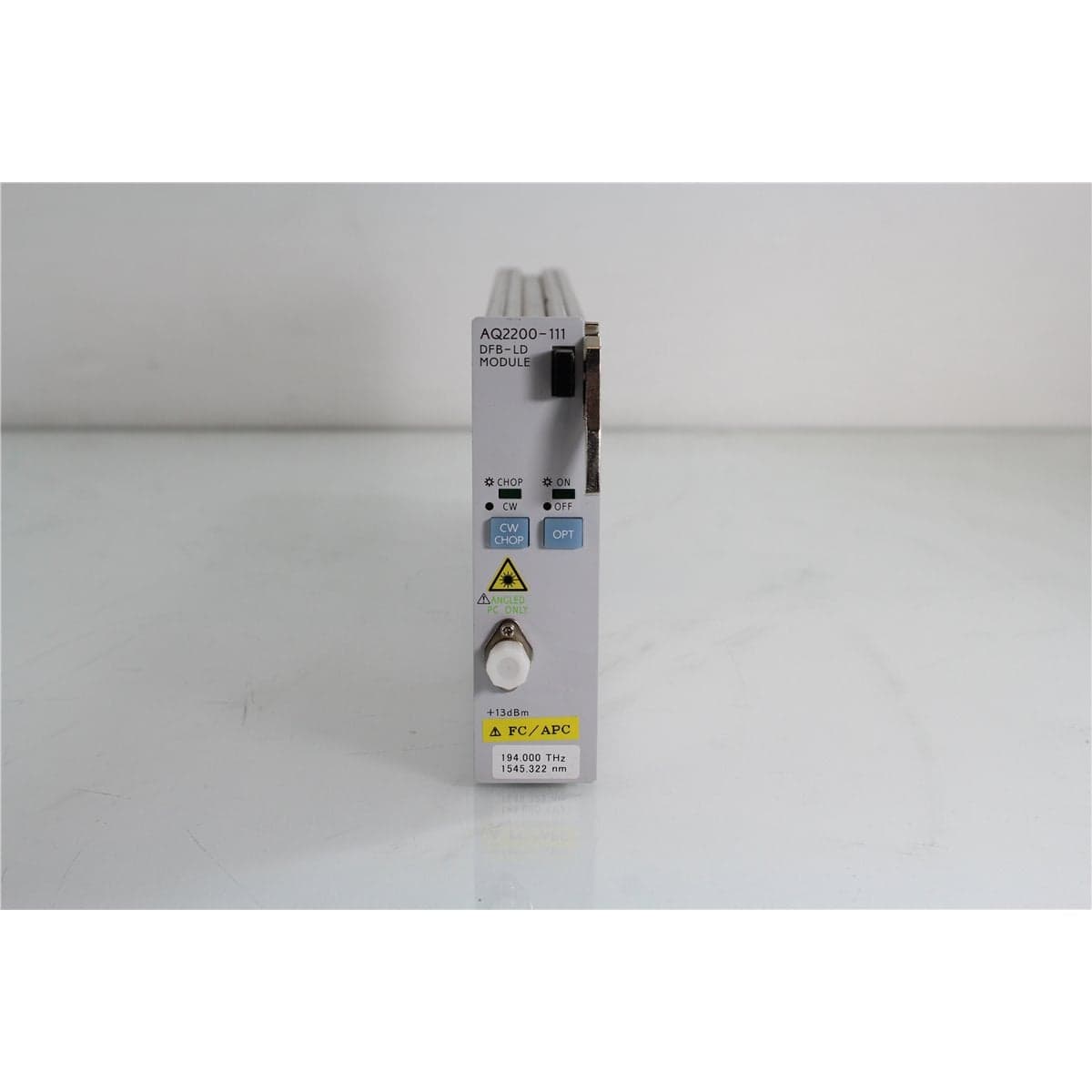
Yokogawa AQ2200-111 1545.322 nm 20 mW DFB Laser Source Module with FC/APC Output
$2,555.20
Price in USD.
- Condition
- Used
- Availability
- In stock
- Model
- AQ2200-111-0180
- Manufacturer
- Yokogawa
- Category
- DFBs
Description
Yokogawa AQ2200-111 1545.322 nm 20 mW DFB Laser Source Module
The Yokogawa AQ2200-111 is a high-stability distributed feedback laser source module designed for the AQ2200 Multi Application Test System. This configuration provides a factory-specified wavelength of 1545.322 nm, corresponding to an optical frequency of 194.000 THz, with a 20 mW optical output option.
The documented P20 output option represents 20 mW, which is approximately +13 dBm. It should not be described as a 20 dBm source, since 20 dBm would correspond to 100 mW. The 20 mW configuration provides useful optical power for DWDM component characterization, optical amplifier testing, receiver evaluation, passive component measurements, and automated optical test systems.
The module uses a DFB laser diode to provide narrow spectral output with controlled longitudinal-mode performance. An FC angled physical-contact optical connector helps reduce back reflections when the module is connected to a clean, compatible FC/APC fiber optic patch cord.
The AQ2200-111 is a plug-in module and does not operate as a standalone light source. A compatible Yokogawa AQ2201 or AQ2202 frame controller is required to supply electrical power, display functions, module control, data storage, and remote communication.
Features and Benefits of the Yokogawa AQ2200-111
- Precise 1545.322 nm wavelength: Provides a factory-specified optical carrier at 194.000 THz for compatible DWDM and telecommunications testing.
- 20 mW output configuration: Supplies approximately +13 dBm of optical power for component, receiver, amplifier, and transmission-system evaluation.
- Distributed feedback laser: Provides narrow spectral output with controlled single-frequency performance.
- Fine wavelength setting: Supports wavelength adjustment with 0.001 nm setting resolution.
- High side-mode suppression: The C- and L-band AQ2200-111 platform provides a typical side-mode suppression ratio of 45 dB.
- Internal optical attenuation: Provides a 10 dB adjustment range for controlling the output level.
- Fine attenuation steps: Allows attenuation to be set in 0.01 dB increments.
- Wavelength stability: Supports stable long-duration optical measurements and automated test sequences.
- FC/APC optical interface: Uses an angled physical-contact connection to help reduce reflected optical power.
- Modular system integration: Operates with compatible AQ2200 sensors, attenuators, optical switches, and other test modules.
- Hot-swappable architecture: Can be inserted or removed from a compatible frame without powering down the complete platform, subject to correct handling and warm-up requirements.
- Automated test support: Uses the GPIB and Ethernet communication capabilities provided by the compatible AQ2200 frame controller.
1545.322 nm DWDM Optical Wavelength
The AQ2200-111 configuration identified by wavelength option M0180 operates at 1545.322 nm. This wavelength corresponds to an optical frequency of 194.000 THz and is located within the C-band region used for wavelength-division multiplexing and telecommunications testing.
A fixed, precisely defined wavelength is useful for characterizing wavelength-selective optical components such as multiplexers, demultiplexers, filters, couplers, switches, isolators, circulators, amplifiers, and receivers.
The module’s specified wavelength accuracy across its C- and L-band configurations is within ±0.02 nm. Wavelength-setting resolution is 0.001 nm, allowing the source setting to be controlled precisely through the compatible frame.
20 mW Optical Output
The P20 option identifies a nominal optical output of 20 mW. This equals approximately +13 dBm and provides more power than the available 10 mW configuration.
The higher output is useful for systems containing passive loss from couplers, switches, multiplexers, attenuators, patch cords, connectors, and devices under test. It can also provide useful input power for compatible optical amplifier measurements.
The exact optical power reaching a device depends on the module output setting, internal attenuation, fiber configuration, connector condition, patch-cord loss, and external components. A calibrated optical power meter should be used when the delivered level must be documented.
Narrowband DFB Laser Performance
The distributed feedback laser design provides narrow spectral output compared with a Fabry-Perot laser source. This supports measurements that require a well-defined optical carrier rather than a broadband or multi-longitudinal-mode signal.
For AQ2200-111 wavelengths from 1524.111 nm to 1620.500 nm, the documented side-mode suppression ratio is typically 45 dB. Strong side-mode suppression helps reduce unwanted spectral content when testing wavelength-selective optical devices.
The source is suitable for DWDM applications, optical amplifier characterization, filter response testing, channel-isolation measurements, receiver testing, and other measurements influenced by source wavelength and spectral purity.
Internal Optical Attenuation
The AQ2200-111 includes an internal optical attenuator with a 10 dB adjustment range. Attenuation can be controlled in 0.01 dB steps through the host frame.
This function allows the source level to be reduced without disconnecting the optical path or installing a separate attenuator for each test. It is practical for receiver sensitivity measurements, optical-level sweeps, gain measurements, and comparative component testing.
The attenuation value does not include losses from external patch cords, connector adapters, switches, couplers, or devices under test. The actual output at the measurement reference plane should be verified with a suitable optical power meter.
Optical Output Stability
The AQ2200-111 is designed as a high-stability reference source for optical device measurements. Documented short-term output stability is within ±0.005 dB over 15 minutes, with 24-hour stability within ±0.03 dB under the applicable test conditions.
Stable output helps distinguish changes caused by a device under test from drift in the source itself. This is important for insertion loss, amplifier gain, receiver response, transmission stability, and automated production measurements.
The module and host frame should complete the appropriate warm-up period before precision measurements are recorded. Fiber connections and environmental conditions should remain stable throughout the test.
FC/APC Optical Output
The AQ2200-111 platform uses an FC angled physical-contact optical connector. A compatible FC/APC patch cord should be used with the module.
The angled ferrule helps reduce reflected optical power returning toward the DFB laser. Lower optical feedback supports stable wavelength and power performance in reflective optical systems.
FC/PC connectors must not be directly intermated with FC/APC interfaces. The different ferrule geometries can result in high insertion loss, poor return loss, unstable measurements, or permanent connector damage.
The module output and mating patch cord should be inspected and cleaned before connection. Protective caps should remain installed whenever the optical interface is not in use.
AQ2200 Frame Controller Compatibility
The AQ2200-111 operates in a compatible AQ2200 Series frame controller. The Yokogawa AQ2201 provides three module slots, while the AQ2202 provides nine slots for larger test-system configurations.
The host frame supplies module power and provides the color display, front-panel controls, module recognition, measurement applications, data storage, GPIB communication, and Ethernet connectivity.
The modular platform allows the DFB source to be combined with optical sensors, variable attenuators, optical switches, and other compatible modules. This supports compact test systems without requiring a separate benchtop instrument for every optical function.
Typical Applications
- 1545.322 nm DWDM channel testing
- Optical multiplexer and demultiplexer characterization
- Optical filter bandwidth and isolation measurements
- Erbium-doped fiber amplifier testing
- Receiver sensitivity evaluation
- Optical attenuator characterization
- Optical switch testing
- Insertion loss measurement
- Wavelength-selective component testing
- Single-mode fiber transmission experiments
- Automated production testing
- Telecommunications research and development
Product Overview
| Brand | Yokogawa |
| Model | AQ2200-111 |
| Product Category | DFB Laser Source Module |
| Wavelength Option | M0180 |
| Configured Wavelength | 1545.322 nm |
| Optical Frequency | 194.000 THz |
| Output Option | P20 |
| Configured Optical Output | 20 mW, approximately +13 dBm |
| Optical Connector | FC/APC |
| Compatible Frames | Yokogawa AQ2201 and AQ2202 frame controllers |
| Standalone Operation | Not supported |
| Primary Application | High-stability DWDM optical stimulus for component and transmission-system testing |
Configured Option Breakdown
| Option | Configuration |
| AQ2200-111 | Distributed feedback laser source module |
| M0180 | 194.000 THz, 1545.322 nm wavelength configuration |
| P20 | 20 mW optical output, approximately +13 dBm |
| Optical Connector | FC angled physical-contact interface |
Optical Specifications
| Specification | Details |
| Laser Type | Distributed feedback laser diode |
| Configured Wavelength | 1545.322 nm |
| Optical Frequency | 194.000 THz |
| Wavelength Accuracy | Within ±0.02 nm for the documented C- and L-band range |
| Wavelength Setting Resolution | 0.001 nm |
| Configured Output Power | 20 mW, approximately +13 dBm |
| Side-Mode Suppression Ratio | 45 dB typical |
| Optical Attenuation Range | 10 dB |
| Attenuation Step | 0.01 dB |
| Optical Connector | FC/APC |
Stability Specifications
| Specification | Documented Performance |
| 15-Minute Output Stability | Within ±0.005 dB |
| 24-Hour Output Stability | Within ±0.03 dB |
| 24-Hour Wavelength Stability | Within ±0.005 nm |
Fiber Configuration Requiring Verification
| Configuration Item | Verification Required |
| Internal Fiber Type | Confirm SMF or PMF from the complete module option code |
| PM Fiber Alignment | Confirm the installed axis orientation if the module uses PMF |
| External Modulation | Confirm whether MODN, MODS, or MODC is installed |
Installation and Operation
The AQ2200-111 should be installed securely in an available slot of a compatible AQ2201 or AQ2202 frame controller. The frame should recognize the source module and provide access to its wavelength, output, attenuation, and modulation settings.
A clean FC/APC patch cord should be connected to the optical output. The module should initially be set to a reduced output level before a new device under test is connected.
The optical level can then be increased gradually while the receiving equipment and device limits are monitored. The module and frame should complete their warm-up period before precision wavelength and power measurements are recorded.
Laser and Connector Safety
The AQ2200-111 produces invisible infrared optical power near 1545 nm. Users should not look into the optical connector, patch cord, adapter, or exposed fiber end.
The optical output should be disabled before connectors are inspected, cleaned, attached, or removed. Appropriate laser-safety procedures should be followed throughout installation and operation.
Only compatible FC/APC interfaces should be connected to the module. FC/PC connectors must not be directly intermated with the angled optical output.
Comprehensive Functional and Performance Testing
The Yokogawa AQ2200-111 receives comprehensive functional and performance testing before shipment. Evaluation may include installation in a compatible AQ2200 frame, module recognition, startup, output enable and disable operation, wavelength setting, internal attenuation, and available modulation functions.
Optical testing may include verification of the 1545.322 nm wavelength, 20 mW output configuration, wavelength accuracy, output stability, side-mode suppression, attenuation range, attenuation-step operation, and optical continuity through the FC/APC interface.
The FC/APC output, module faceplate, frame connector, controls, enclosure, labels, fiber interface, and option markings may be inspected for contamination, damage, corrosion, or excessive wear.
The exact testing scope depends on the available AQ2200 frame, wavelength meter, optical spectrum analyzer, optical power meter, FC/APC reference cable, modulation source, and requested test points.
Calibration Before Shipment
When technically applicable and selected, the Yokogawa AQ2200-111 can be calibrated or performance-verified before shipment. Evaluation may include center wavelength, wavelength accuracy, output power, attenuation accuracy, short-term stability, wavelength stability, side-mode suppression, and available modulation functions.
Calibration documentation should identify the module model and serial number, wavelength option, output option, fiber configuration, modulation option, host frame, warm-up time, attenuation settings, reference cable, measurement equipment, recorded results, and applicable measurement uncertainty.
Buyers requiring formal calibration should specify the required wavelength tolerance, optical power points, attenuation settings, stability interval, spectral measurements, certificate format, recorded results, and required measurement uncertainty before purchase.
Why Buy from AssetRelay?
AssetRelay supplies professional equipment and product solutions for fiber optic, telecommunications, optical testing, photonics, laboratory, production, inspection, electronic testing, RF/microwave, and technical research applications. The Yokogawa AQ2200-111 provides a stable modular DWDM source for optical component manufacturers, amplifier developers, telecommunications laboratories, production facilities, system integrators, universities, and research organizations.
Buyers should review the 1545.322 nm wavelength configuration, 20 mW output option, FC/APC connector, internal fiber type, modulation option, attenuation operation, compatible frame requirements, functional test results, calibration status, and included accessories before purchase.