
HP · 8168D_021
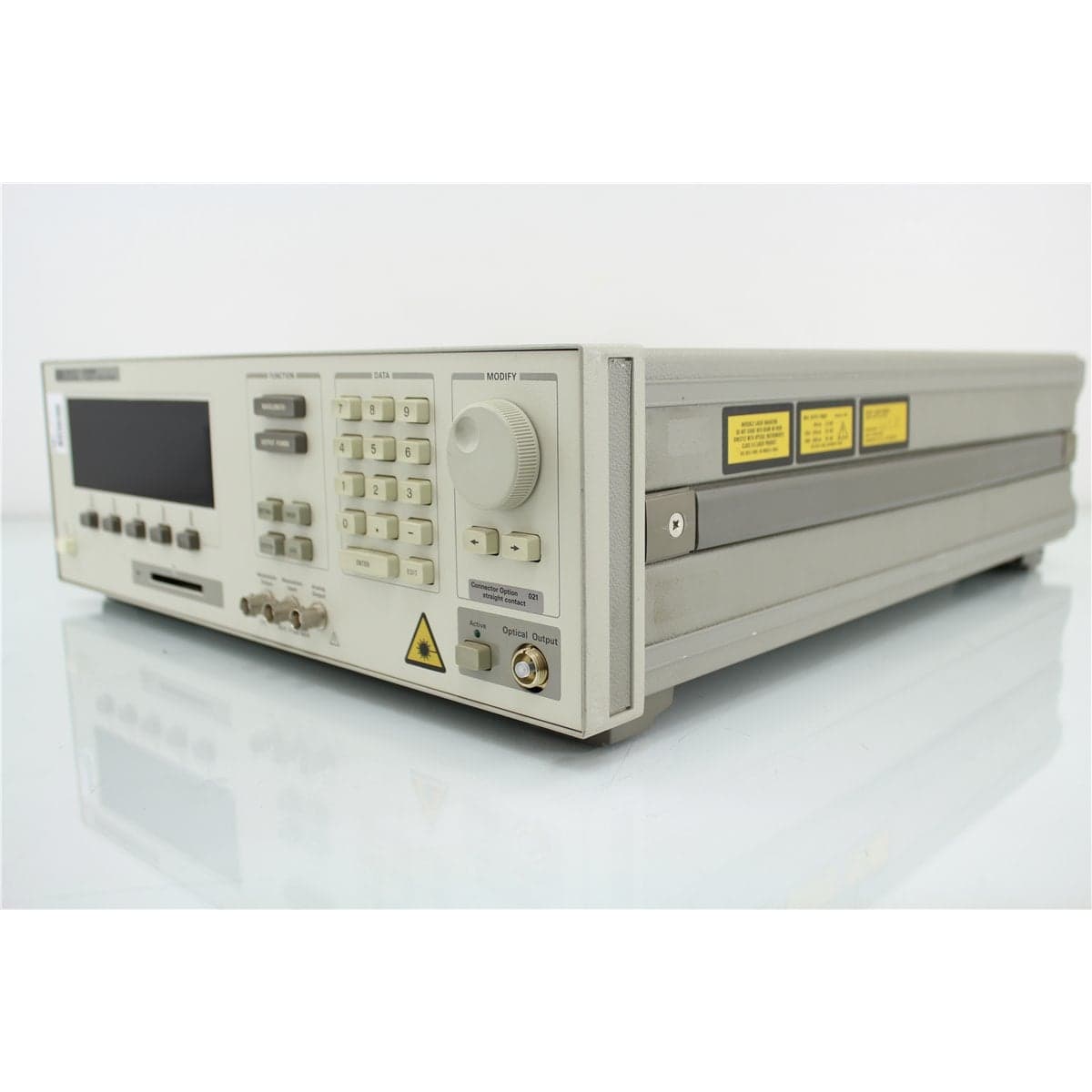
HP Agilent 8168D Tunable Laser Source S+C Band 1470-1580nm DWDM Fiber Tester
$5,755.20
Price in USD.
- Condition
- Used
- Availability
- In stock
- Model
- 8168D_021
- Manufacturer
- HP
- Category
- Tunable Laser Sources
Description
HP Agilent 8168D Tunable Laser Source S+C Band 1470-1580nm DWDM Fiber Tester: Precision Tunable Laser Source for DWDM Component Testing
The HP Agilent 8168D Tunable Laser Source S+C Band 1470-1580nm DWDM Fiber Tester is a tunable laser source covering the 1490 to 1565 nm range across the S and C bands. Built for DWDM component testing, spectral characterization, and laboratory research applications, it targets engineers who need a stable tunable source with picometer-class wavelength control from a single instrument.
Key Features and Benefits of the HP Agilent 8168D Tunable Laser Source S+C Band 1470-1580nm DWDM Fiber Tester
- 1490 to 1565 nm wavelength range — Covers the primary C-band DWDM region from a single instrument for broad component and system characterization.
- ±0.2 nm absolute wavelength accuracy (typical) — Delivers reliable wavelength positioning for ITU-grid channel verification and filter characterization.
- ±0.1 nm relative wavelength accuracy — Consistent relative wavelength control across the tuning range supports accurate delta-wavelength measurements.
- 0.1 nm wavelength resolution — Fine step size enables detailed sweeps across filter passbands and DWDM channels.
- >-4 dBm peak output power (typical) — Provides usable launch power for loss-budget testing and component characterization.
- <-40 dB/0.1 nm source spontaneous emission (1500–1565 nm) — Low broadband noise floor for high-contrast measurements adjacent to the carrier.
- <-145 dB/Hz relative intensity noise (typical) — Low RIN preserves signal quality for sensitive detection applications.
- 100 kHz linewidth typical — Narrow linewidth (with coherence control off) suits coherent measurements and fine spectral work.
- Coherence control on/off modes — Selectable linewidth broadening allows suppression of interference fringes when needed.
Advanced Capabilities
The 8168D's coverage of the 1490 to 1565 nm range makes it a workhorse for DWDM component labs working across the S and C bands. Combined with ±0.1 nm relative wavelength accuracy and 0.1 nm setting resolution, the instrument delivers the precision needed to sweep across ITU-grid channels and characterize filter passbands with confidence.
Coherence control is the other feature worth calling out. With coherence control off, the effective linewidth is typically 100 kHz — narrow enough for interferometric and coherent-detection measurements. With coherence control on, the effective linewidth broadens to 30–500 MHz, which is what's needed to suppress interference fringes and speckle noise when measuring reflective components like FBGs and connectors. Having both modes available from the same instrument means the source can be matched to the measurement rather than the other way around.
Calibration and Quality Assurance
Every HP Agilent 8168D is calibrated prior to shipping to OEM specifications. The order includes a Calibration Certificate, Calibration Label, and full Calibration Data. This means the instrument arrives traceable, audit-ready, and ready to use straight out of the box — no need to schedule a calibration cycle before putting it into service.
Specifications
| Specification | Value |
|---|---|
| Wavelength Range | 1490 nm to 1565 nm |
| Absolute Wavelength Accuracy (typical) | ±0.2 nm |
| Relative Wavelength Accuracy | ±0.1 nm (1490–1565 nm) |
| Wavelength Resolution | 0.1 nm |
| Wavelength Stability (typical, over 1 hour at constant temperature) | ±1 GHz |
| Wavelength Repeatability | ±0.1 nm (1490–1565 nm) |
| Source Spontaneous Emission | < -40 dB/0.1 nm (1500–1565 nm); < -35 dB/0.1 nm (1490–1565 nm) |
| Relative Intensity Noise (RIN, typical) | < -145 dB/Hz |
| Linewidth (typical, coherence control off) | 100 kHz |
| Effective Linewidth (typical, coherence control on) | 30 to 500 MHz (1500–1565 nm) |
| Output Power (peak, typical) | > -3 dBm |
| Output Power (1500–1565 nm) | > -4 dBm |
| Output Power (1490–1565 nm) | > -10 dBm |
| Minimum Output Power | -10 dBm |
| Power Linearity | ±0.1 dB |
| Power Stability (over 1 hour) | ±0.03 dB |
| Power Repeatability (typical) | ±0.04 dB |
| Power Flatness vs. Wavelength | ±0.2 dB (1490–1565 nm), typical ±0.1 dB (1500–1565 nm) |