
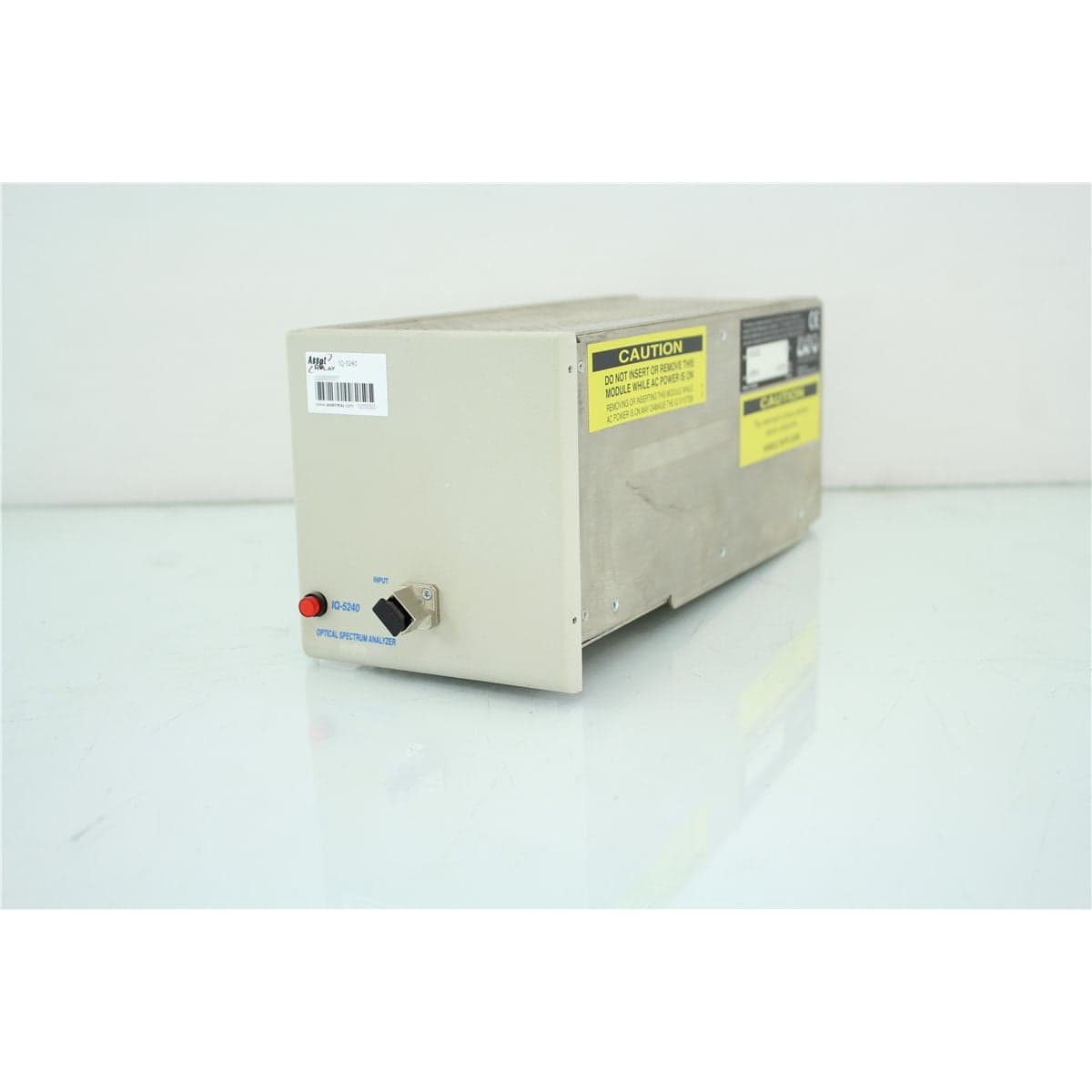
Exfo · IQ-5240
EXFO IQ-5240 Optical Spectrum Analyzer, 1250 nm to 1650 nm
$2,395.20
Price in USD.
- Condition
- Used
- Availability
- In stock · 2 available
- Model
- IQ-5240
- Manufacturer
- Exfo
- Category
- Optical Spectrum Analyzers (OSA)
Description
EXFO IQ-5240 Optical Spectrum Analyzer
The EXFO IQ-5240 is a modular optical spectrum analyzer designed for high-resolution measurement and analysis of optical signals from 1250 nm to 1650 nm. It integrates with the EXFO IQ-200 Optical Test System to support WDM testing, EDFA characterization, optical component evaluation, spectral measurements, production workflows, and long-term signal monitoring.
The IQ-5240 uses a double-pass Littman-Metcalf monochromator to provide narrow filter resolution bandwidth and strong rejection of nearby optical signals. Its optical design combines a single diffraction grating with double-pass operation, a gearless DC motor, and a high-resolution encoder for controlled wavelength positioning.
The analyzer offers a maximum data-point resolution of 5 pm and a characteristic resolution bandwidth of 65 pm in the C-band. The instrument can collect up to 10,001 data points and supports fast sweeps for applications that require detailed spectrum acquisition without extended measurement times.
Features and Benefits of the EXFO IQ-5240
The EXFO IQ-5240 provides practical optical spectrum analysis for engineers and technical teams working with WDM systems, optical amplifiers, transmitters, sources, filters, and other photonic components.
- 1250 nm to 1650 nm wavelength range: Supports optical spectrum measurements across common telecom and photonics wavelength regions.
- 5 pm maximum data-point resolution: Provides detailed trace acquisition for closely spaced optical signals and wavelength-selective components.
- 65 pm C-band resolution bandwidth: Supports high-resolution spectral analysis with a steep optical rejection response.
- Wide optical power range: Measures compatible signals from -75 dBm to +15 dBm under the documented conditions.
- Optimized dynamic range: Helps distinguish lower-level optical signals and amplified spontaneous emission near stronger spectral peaks.
- Fast sweep performance: Acquires 5,000 raw data points across a 35 nm span in less than one second within the IQ-200 Optical Test System.
- Automated WDM analysis: Measures central wavelength, optical power, and signal-to-noise ratio for detected optical peaks.
- EDFA analysis: Supports gain and related amplifier parameter measurements.
- Drift analysis: Measures, displays, and reports changes in peak wavelength and optical power over time.
- Remote control: Supports SCPI commands and GPIB or RS-232 communication through the compatible system configuration.
High-Resolution Optical Spectrum Measurements
The EXFO IQ-5240 provides an optical wavelength range from 1250 nm to 1650 nm. Its adjustable measurement span extends from the full wavelength range down to 1 nm, allowing users to select a broad overview or focus on a specific spectral region.
The maximum data-point resolution is 5 pm. Resolution bandwidth is characterized at 65 pm in the C-band, supporting measurements on densely spaced optical channels, narrow optical sources, filters, and wavelength-selective components.
Wavelength uncertainty is specified at ±50 pm within the C-band and L-band after external calibration. Wavelength linearity is ±10 pm within these bands, and one-minute wavelength repeatability is less than 5 pm.
Double-Pass Littman-Metcalf Monochromator
The IQ-5240 uses a double-pass Littman-Metcalf monochromator. This arrangement provides a narrow filter bandwidth with a steep rejection shape that helps separate lower-level optical signals located near stronger spectral components.
The analyzer uses a single grating in a double-pass optical path. A gearless DC motor rotates the grating, while a high-resolution encoder tracks and controls the filter position.
This design supports stable wavelength alignment between the monochromator input fiber and output slit. The controlled optical path contributes to wavelength linearity, repeatability, filter resolution, and consistent power measurements.
Dynamic Range for WDM Measurements
High dynamic range is important when measuring weak optical signals positioned near strong WDM peaks. Insufficient rejection can obscure secondary wavelengths, amplified spontaneous emission, or signals generated by nonlinear optical effects.
In the C-band, the IQ-5240 provides a dynamic range greater than 50 dBc at 1 nm from a peak. Dynamic range is greater than 45 dBc at 0.4 nm and greater than 35 dBc at 0.2 nm from the peak.
The analyzer’s optical rejection performance supports many systems with 50 GHz channel spacing. This capability is useful when evaluating channel isolation, nearby noise, WDM signal quality, and lower-level spectral features.
Optical Power Measurements
The EXFO IQ-5240 measures optical power from -75 dBm to +15 dBm. The low-level specification requires averaging, while the high-level limit applies to a single optical peak.
Optical power uncertainty is specified at ±0.4 dB at -10 dBm and at the calibration wavelengths of 1310 nm and 1550 nm. Power linearity is ±0.1 dB over a 20 dB range and ±0.2 dB over a 40 dB range.
Typical power uniformity in the C-band is ±0.1 dB, while one-minute power repeatability is ±0.05 dB. These characteristics support comparative optical level measurements, channel-power analysis, amplifier testing, and production verification.
Low Polarization Sensitivity
The IQ-5240 is designed to reduce changes in measured optical loss caused by the input polarization state. Typical polarization sensitivity is ±0.1 dB, with a specified maximum of ±0.15 dB within the C-band and L-band.
Low polarization sensitivity supports repeatable measurements of polarized and polarization-varying optical signals. Actual results also depend on connector condition, patch-cord movement, source stability, optical power, calibration status, and environmental conditions.
Fast Sweep Performance
The EXFO IQ-5240 supports a sweep time of less than one second when acquiring 5,000 raw data points across a 35 nm span in real-time operation within the IQ-200 Optical Test System.
The analyzer can collect up to 10,001 data points, depending on the selected measurement range. This capability supports detailed trace acquisition while allowing users to configure the balance among span, resolution, data density, and measurement speed.
Measurement data can be stored in ASCII format or EXFO OSW format. The OSW file format supports subsequent analysis and reporting with the same application software used for data acquisition.
Automated WDM Analysis
The IQ-5240 includes automated analysis functions for WDM signals. The analyzer can identify optical peaks and report central wavelength, optical power, and signal-to-noise ratio for each detected channel.
These functions simplify measurements on multiplexed optical systems by organizing channel information into a practical analysis format. The analyzer supports applications involving channel-power equalization, wavelength verification, SNR evaluation, spectral monitoring, and WDM component characterization.
Signal-to-noise ratio can be measured directly using the actual resolution bandwidth or calculated using a 0.1 nm reference bandwidth.
EDFA and Total-Power Analysis
The IQ-5240 supports EDFA analysis for measuring amplifier gain and related parameters. This capability is useful for laboratory development, amplifier qualification, production testing, and maintenance of erbium-doped fiber amplifier systems.
Total optical power can be determined using either a peak-based definition or an integrated measurement between user-defined limits. Integrated power measurement is helpful when evaluating broadband sources, amplifier noise, wide spectral features, and optical signals distributed across a selected wavelength interval.
Appropriate reference measurements, wavelength settings, optical levels, and test configurations should be used when calculating amplifier gain or comparing input and output spectra.
Trace Management and Drift Analysis
The IQ-5240 application software allows operations to be performed on two or more traces. Up to four traces can be acquired and accessed for processing and analysis.
An incoming trace can be configured as a drift curve or a spectral-distribution curve. A drift curve records changes in power and central wavelength over time, while a spectral-distribution curve represents the measured wavelength spectrum at a selected time.
Users can define drift-analysis parameters such as acquisition period and sampling rate. The drift-analysis function supports monitoring of more than 100 optical channels, making it useful for multi-channel stability studies and long-term WDM system evaluation.
Typical Applications
The EXFO IQ-5240 Optical Spectrum Analyzer is suitable for professional applications such as:
- WDM and DWDM channel analysis
- Central wavelength and optical power measurements
- Optical signal-to-noise ratio analysis
- 50 GHz-spaced WDM system evaluation
- EDFA gain and parameter measurements
- Amplified spontaneous emission analysis
- Optical source characterization
- Optical filter and component testing
- Spectral distribution measurements
- Long-term wavelength and power drift analysis
- Production testing and quality control
- Telecom and photonics research
Product Overview
| Brand | EXFO |
| Model | IQ-5240 |
| Product Category | Modular Optical Spectrum Analyzer |
| Wavelength Range | 1250 nm to 1650 nm |
| Optical Power Range | -75 dBm to +15 dBm |
| Maximum Data-Point Resolution | 5 pm |
| Resolution Bandwidth | 65 pm characteristic value in the C-band |
| Platform | EXFO IQ-200 Optical Test System |
| Remote Control | SCPI commands with GPIB and RS-232 interfaces |
| Primary Application | High-resolution WDM, EDFA, optical power, and spectral analysis |
Wavelength Specifications
| Specification | Details |
| Wavelength Range | 1250 nm to 1650 nm |
| Adjustable Span | Full wavelength range down to 1 nm |
| Maximum Data-Point Resolution | 5 pm |
| Resolution Bandwidth | 65 pm characteristic value in the C-band |
| Wavelength Uncertainty | ±50 pm within the C-band and L-band after external calibration |
| Wavelength Linearity | ±10 pm within the C-band and L-band |
| Wavelength Repeatability | Less than 5 pm over one minute |
Optical Power Specifications
| Specification | Details |
| Optical Power Range | -75 dBm to +15 dBm |
| Power Uncertainty | ±0.4 dB at -10 dBm and calibration wavelengths of 1310 nm and 1550 nm |
| Power Linearity Over 20 dB Range | ±0.1 dB |
| Power Linearity Over 40 dB Range | ±0.2 dB |
| Typical C-Band Uniformity | ±0.1 dB |
| Power Repeatability | ±0.05 dB over one minute |
| Typical Polarization Sensitivity | ±0.1 dB within the C-band and L-band |
| Maximum Polarization Sensitivity | ±0.15 dB within the C-band and L-band |
Dynamic Range Specifications
| Peak Separation | C-Band Dynamic Range |
| 1 nm from Peak | Greater than 50 dBc |
| 0.4 nm from Peak | Greater than 45 dBc |
| 0.2 nm from Peak | Greater than 35 dBc |
Sweep, Storage, and Analysis Specifications
| Specification | Details |
| Sweep Time | Less than one second for a 35 nm span and 5,000 raw data points within the IQ-200 Optical Test System |
| Maximum Number of Data Points | 10,001, depending on the selected range |
| Data Storage Formats | ASCII and EXFO OSW |
| WDM Analysis | Central wavelength, optical power, and signal-to-noise ratio for each detected peak |
| EDFA Analysis | Gain and related amplifier parameters |
| Total Power Measurement | Peak-based or integrated between user-defined wavelength limits |
| Drift Analysis | Time-based peak power and central-wavelength monitoring |
| Accessible Traces | Up to four for processing and analysis |
General and Environmental Specifications
| Specification | Details |
| Dimensions with IQ-200 Optical Test System | 14.5 cm high x 36 cm wide x 30.5 cm deep |
| Dimensions in Inches | 5.75 in high x 14.25 in wide x 12 in deep |
| Weight with IQ-203 Optical Test System | 8 kg |
| Weight in Pounds | 17.5 lb |
| Operating Temperature | 10 °C to 40 °C |
| Storage Temperature | -20 °C to 50 °C |
| Humidity | Less than 95% relative humidity, non-condensing |
| Remote Commands | SCPI |
| Instrument Interfaces | GPIB and RS-232 |
Optical Connector Configurations
| Configuration | Description |
| EI | EXFO UPC Universal Interface |
| EA | EXFO APC Universal Interface |
| EUI-89 | FC removable universal connector adapter |
| EUI-91 | SC removable universal connector adapter |
| EUI-95 | E-2000 removable universal connector adapter |
The fixed optical baseplate and removable connector adapter are configuration-specific. Buyers should verify whether the analyzer has the EI UPC or EA APC interface and identify the installed FC, SC, or E-2000 adapter before selecting compatible optical patch cords.
IQ-200 Optical Test System Integration
The IQ-5240 is designed for the EXFO IQ-200 Optical Test System. The modular platform allows the analyzer to operate alongside compatible EXFO LEDs, amplified spontaneous emission sources, optical power meters, wavelength meters, and other test modules.
Combining several optical instruments within one platform helps reduce external cabling, streamline automated measurements, and create integrated laboratory or production test stations.
The exact IQ-200 platform, controller, available module positions, system software, interface configuration, and instrument drivers should be checked before integrating the IQ-5240 into an existing system.
Measurement Setup and Optical Care
Published specifications apply at 23 °C ±2 °C using an FC/UPC connector after the required warm-up period. The analyzer is factory-calibrated within the C-band and L-band, while the specified wavelength uncertainty applies after external calibration.
The installed universal interface and removable connector adapter should be identified before use. UPC and APC connectors should not be mated directly because their ferrule geometries differ and incompatible mating can cause excessive loss, reflection, or physical damage.
All fiber connectors and optical adapters should be inspected and cleaned before connection. Contamination, scratches, damaged ferrules, and poor mating can affect optical power, wavelength accuracy, dynamic range, return loss, and measurement repeatability.
Calibration and Testing Before Shipment
When calibration is technically applicable and supported, the EXFO IQ-5240 is calibrated before shipment. The calibration process may include wavelength uncertainty, wavelength linearity, wavelength repeatability, power uncertainty, power linearity, polarization sensitivity, dynamic range, resolution, and optical return loss at selected wavelengths.
Following successful calibration, the analyzer may include a calibration label, calibration certificate, and associated measurement data, depending on the selected calibration service and equipment condition.
If formal calibration is unavailable or not included, the IQ-5240 receives comprehensive functional and performance testing. Testing may include IQ-200 system recognition, spectrum acquisition, wavelength sweeps, optical power response, trace display, WDM analysis, EDFA functions, drift analysis, data storage, and supported remote communication.
The exact calibration scope, wavelength range, connector configuration, supplied optical data, compatible IQ-200 platform, software, documentation, and service records should be confirmed before purchase when these items are required for laboratory, manufacturing, regulatory, or quality-management applications.
Buyer Considerations
The EXFO IQ-5240 is a modular optical spectrum analyzer and requires a compatible EXFO IQ-200 Optical Test System for complete operation. Buyers should confirm platform compatibility, available module positions, software support, remote interfaces, and included system components.
The installed connector configuration should be verified carefully. The analyzer may use an EI UPC or EA APC universal baseplate with an FC, SC, or E-2000 removable adapter. The connector polish and adapter family must match the intended optical patch cord.
Buyers should review the optical input, connector adapter, module enclosure, system recognition, wavelength measurements, power response, calibration status, included software, and supplied accessories. Only components specifically identified in the product listing should be considered included.
Why Buy from AssetRelay?
AssetRelay supplies professional equipment and product solutions for fiber optic, telecom, laboratory, production, inspection, cleaning, RF/microwave, electronic test, and photonics applications. The EXFO IQ-5240 supports engineers, laboratories, production facilities, procurement teams, and service organizations that require high-resolution optical spectrum, WDM, EDFA, and long-term drift analysis.
Buyers should review the available product photographs, physical condition, optical interface, connector adapter, IQ-200 compatibility, included accessories, calibration information, and application requirements before purchase.
Only accessories and system components specifically identified in the product listing should be considered included. A compatible EXFO IQ-200 Optical Test System, controller, optical adapters, patch cords, software, interface cables, reference sources, and supporting test equipment may be required separately.