
JDS · TB9226-1FP1
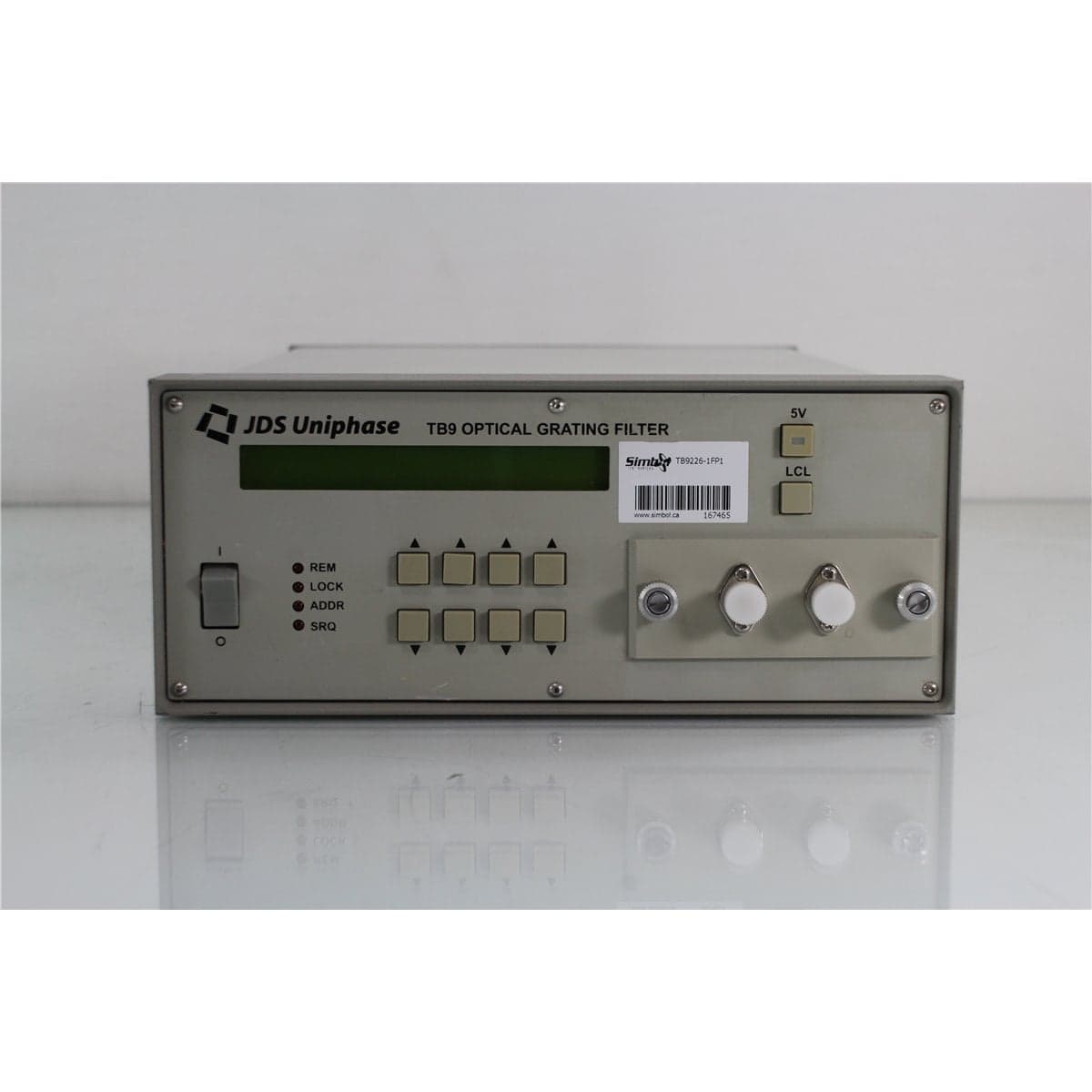
JDSU TB9226+1FP1 TB9 C-Band Tunable Grating Filter with FC/HPC Front Bulkheads
$2,552.00
Price in USD.
- Condition
- Used
- Availability
- In stock
- Model
- TB9226-1FP1
- Manufacturer
- JDS
- Category
- Tunable Filters
Description
JDSU TB9226+1FP1 TB9 C-Band Tunable Grating Filter with FC/HPC Front Bulkheads
The JDSU TB9226+1FP1 is a programmable diffraction grating filter designed for high-performance laboratory and production testing of single-mode fiber optic components and subsystems. It provides wavelength-selective optical filtering for isolating desired signals while suppressing amplified spontaneous emission, broadband optical noise, and unwanted spectral content from laser sources.
This configuration uses the narrowband TB9226 filter model with the C-band wavelength option, FC/HPC optical connectors, and front-panel bulkheads. Optical performance is optimized from 1530 nm to 1570 nm, while the filter can be controlled across a broader wavelength range from 1460 nm to 1575 nm.
The TB9226+1FP1 provides a nominal -3 dB bandwidth of 0.25 nm, a nominal -20 dB bandwidth of 0.7 nm, and wavelength adjustment with 0.01 nm resolution. The filter can be operated from its front-panel keypad or controlled remotely through IEEE 488 and RS232C interfaces for integration into automated optical measurement systems.
Features and Benefits of the JDSU TB9226+1FP1
The JDSU TB9226+1FP1 provides precise wavelength-selective filtering for engineers, laboratories, production facilities, and service organizations working with C-band optical components and communication systems.
- Grating-based optical filter: Uses a programmable diffraction grating design to provide narrow passbands and strong out-of-band wavelength rejection.
- C-band optimized performance: Provides specified optical performance from 1530 nm to 1570 nm.
- Broad wavelength control: Supports filter tuning from 1460 nm to 1575 nm.
- Narrow 0.25 nm passband: Provides a nominal -3 dB bandwidth of 0.25 nm for selective optical filtering.
- High spectral rejection: Provides a nominal -20 dB bandwidth of 0.7 nm.
- Fine wavelength adjustment: Supports a wavelength resolution of 0.01 nm.
- Single-mode optical path: Uses single-mode fiber at the optical input and output.
- FC/HPC connectors: Provides compatible straight-contact FC optical interfaces.
- Front-panel bulkheads: Places the optical input and output on the front panel for convenient access.
- Front-panel operation: Supports local filter control through the integrated keypad.
- Remote automation: Includes IEEE 488 and RS232C interfaces for computer-controlled testing.
Narrowband Diffraction Grating Filter
The JDSU TB9 Series uses a grating-based optical architecture to select a narrow spectral region while rejecting wavelengths outside the desired passband. The filter design is available in single-pass and double-pass grating configurations to support narrow bandwidth and high rejection.
The TB9226 is the narrowest standard filter model documented for this TB9 Series. It provides a nominal -3 dB bandwidth of 0.25 nm and a nominal -20 dB bandwidth of 0.7 nm. Both bandwidth values have a tolerance of ±15%.
This narrow optical response is useful for isolating individual channels, suppressing broadband noise, and separating a selected laser wavelength from surrounding spontaneous-emission content. Actual performance can also be influenced by wavelength, polarization, temperature, connector condition, source characteristics, and calibration status.
C-Band Optical Performance
The TB9226+1FP1 is configured with wavelength-range code 1, identifying the C-band version optimized from 1530 nm to 1570 nm. Within this range, insertion loss is specified at 6.0 dB and polarization-dependent loss is specified at 0.2 dB.
The filter can be controlled across wavelengths from 1460 nm to 1575 nm, allowing users to position the passband beyond the primary 1530 nm to 1570 nm specification window when required. Optical performance outside the optimized C-band window should be evaluated according to the needs of the particular application.
Wavelength repeatability is specified at 0.05 nm, while wavelength accuracy is specified at 0.2 nm. The 0.01 nm resolution supports fine incremental adjustment of the selected filter wavelength.
Amplified Spontaneous Emission Filtering
The JDSU TB9226+1FP1 can be used for amplified spontaneous emission filtering in erbium-doped fiber amplifier systems. EDFAs can produce broadband ASE in addition to the desired amplified optical signal. This unwanted spectral energy can interfere with accurate optical measurements and component characterization.
The grating filter can be tuned to pass the desired wavelength while rejecting surrounding ASE. This supports amplifier gain measurements, wavelength-dependent testing, source cleanup, and evaluation of components positioned after an optical amplifier.
The narrow 0.25 nm nominal passband is particularly useful where selective filtering and strong rejection are required. The filter insertion loss, input power, polarization dependence, and connector characteristics should be considered when configuring the complete measurement system.
Spontaneous-Emission Suppression for Laser Sources
The JDSU TB9226+1FP1 can also suppress spontaneous emission from distributed feedback lasers and tunable laser sources. Laser output may contain a desired narrow carrier together with lower-level optical energy outside the primary wavelength.
By tuning the grating filter to the laser wavelength, users can reduce unwanted spectral content before the signal reaches a wavelength-selective component, optical detector, receiver, or other device under test.
For tunable-laser-based measurements, the filter wavelength can be coordinated with the source through the IEEE 488 or RS232C interface. This enables automated channel selection and wavelength sweeps across the available operating range.
WDM and DWDM Component Testing
The JDSU TB9226+1FP1 is suitable for wavelength-selective testing of WDM and DWDM components. The filter can help isolate the required optical channel before or after a device under test.
Typical devices may include optical filters, multiplexers, demultiplexers, wavelength-selective switches, couplers, fiber Bragg gratings, arrayed waveguide gratings, optical amplifiers, and other active or passive photonic components.
The filter can be coordinated with a compatible tunable laser, optical power meter, spectrum analyzer, optical switch, or variable attenuator. This supports channel-by-channel measurements, wavelength sweeps, insertion-loss testing, passband evaluation, and spectral-rejection analysis.
Typical Applications
The JDSU TB9226+1FP1 Tunable Grating Filter is suitable for professional applications such as:
- Amplified spontaneous emission filtering
- EDFA characterization and testing
- Spontaneous-emission suppression
- DFB laser source cleanup
- Tunable laser testing
- WDM and DWDM component characterization
- Optical filter evaluation
- MUX and DEMUX testing
- Fiber Bragg grating measurements
- Arrayed waveguide grating testing
- C-band wavelength-selective measurements
- Automated laboratory and production testing
Product Overview
| Brand | JDSU / JDS Uniphase |
| Model | TB9226+1FP1 |
| Product Family | TB9 Series Diffraction Grating Filters |
| Filter Model | TB9226 |
| Product Category | Programmable Single-Mode Tunable Grating Filter |
| Wavelength Configuration | C-band |
| Fiber Configuration | Single-mode fiber input and output |
| Connector Type | FC/HPC |
| Port Configuration | Bulkheads on front |
| Primary Application | Narrowband wavelength-selective filtering for C-band optical testing |
TB9226 Optical Specifications
| Specification | JDSU TB9226+1FP1 Details |
| Optimized Optical Range | 1530 nm to 1570 nm |
| Controllable Tuning Range | 1460 nm to 1575 nm |
| Nominal -3 dB Bandwidth | 0.25 nm |
| -3 dB Bandwidth Tolerance | ±15% |
| Nominal -20 dB Bandwidth | 0.7 nm |
| -20 dB Bandwidth Tolerance | ±15% |
| Insertion Loss, 1530–1570 nm | 6.0 dB |
| Polarization-Dependent Loss, 1530–1570 nm | 0.2 dB |
| Wavelength Resolution | 0.01 nm |
| Return Loss | Greater than 45 dB |
| Wavelength Repeatability | 0.05 nm |
| Wavelength Accuracy | 0.2 nm |
TB9226+1FP1 Configuration Details
| Configuration Field | Selected Configuration |
| Base Model | TB9226 |
| Model Code | 226 |
| Wavelength-Range Code | 1 |
| Wavelength Configuration | C-band, 1530 nm to 1570 nm optimized range |
| Connector Code | FP |
| Connector Type | FC/HPC |
| Port Code | 1 |
| Port Type | Bulkheads on front |
Control and Automation Interfaces
| Control Method | Details |
| Local Control | Front-panel keypad |
| Parallel Remote Interface | IEEE 488 |
| Serial Remote Interface | RS232C |
| Automation Application | Remote wavelength selection and coordination with compatible optical test equipment |
Electrical, Environmental, and Mechanical Specifications
| Specification | Details |
| Input Voltage | 100 V AC to 240 V AC |
| Line Frequency | 50 Hz to 60 Hz |
| Maximum Power Consumption | 80 VA |
| Dimensions | 21.2 cm wide x 8.9 cm high x 35.5 cm deep |
| Rack Format | 19-inch rack compatible, 2U high, half-rack width |
| Weight | 4 kg |
| Operating Temperature | 10 °C to 40 °C |
| Storage Temperature | 0 °C to 50 °C |
| Humidity | Up to 95% relative humidity at 40 °C |
FC/HPC Front-Panel Optical Interfaces
The TB9226+1FP1 uses FC/HPC connectors with optical bulkheads mounted on the front panel. Compatible straight-contact FC single-mode patch cords should be used for the filter input and output.
FC/HPC and FC/APC connectors use different end-face geometries and should not be mated directly. The connector polish and key configuration should be verified before connecting the filter to a laser source, device under test, optical amplifier, or power meter.
All optical connector end faces should be inspected and cleaned before mating. Contamination can increase insertion loss, reduce return loss, introduce measurement instability, and affect the measured filter response.
Measurement Preparation
The desired wavelength should be selected through the front-panel keypad or remote interface before beginning the measurement. Users should verify that the selected wavelength and optical source fall within the TB9226+1FP1 tuning and optimized-performance ranges.
The filter should be connected using clean, compatible single-mode patch cords. Fiber movement, connector contamination, polarization changes, and temperature variation can affect insertion loss, wavelength response, and repeatability.
The complete optical setup should be evaluated for source power, connector compatibility, insertion loss, detector sensitivity, and device-under-test limitations before the source is enabled.
Calibration and Testing Before Shipment
When calibration is technically applicable and supported, the JDSU TB9226+1FP1 is calibrated before shipment. The calibration process may include verification of wavelength accuracy, wavelength repeatability, tuning resolution, passband width, insertion loss, polarization-dependent loss, front-panel operation, and remote-interface control.
Following successful calibration, the instrument may include a calibration label, calibration certificate, and related calibration data, depending on the equipment configuration and calibration service.
If formal calibration is unavailable or not applicable to the specific instrument, the unit receives comprehensive functional and performance testing. This process may include wavelength tuning across the available range, optical transmission checks, filter-response evaluation, connector inspection, keypad operation, display functions, IEEE 488 communication, and RS232C control.
This testing helps verify that the equipment operates correctly and that its available functions have been evaluated before it is released for shipment. The exact calibration scope, documentation, test data, and service records should be confirmed before purchase when these items are required for laboratory, production, regulatory, or quality-management applications.
Buyer Considerations
The JDSU TB9226+1FP1 is a configuration-specific tunable grating filter. Buyers should confirm that the C-band optimized range, broader 1460 nm to 1575 nm tuning capability, 0.25 nm nominal passband, FC/HPC connectors, and front-panel bulkheads match the intended optical system.
The TB9226+1FP1 should not be confused with later TB90226 configurations that may use different part-number structures, documented passband values, wavelength-range codes, or optical options. This description applies specifically to the TB9226+1FP1 configuration documented for the earlier TB9 Series.
Buyers should review the optical connector condition, wavelength-tuning operation, filter transmission, front-panel controls, IEEE 488 and RS232C interfaces, calibration status, service history, and included accessories before purchase.
Why Buy from AssetRelay?
AssetRelay supplies professional equipment and product solutions for fiber optic, telecom, laboratory, production, inspection, cleaning, RF/microwave, electronic test, and photonics applications. The JDSU TB9226+1FP1 Tunable Grating Filter is listed to help engineers, laboratory personnel, production facilities, procurement teams, and service organizations source narrowband optical filtering equipment for professional test systems.
Buyers should review the available product photographs, physical condition, connector type, included accessories, calibration information, and application requirements before purchase. Confirming these details helps ensure that the filter matches the intended wavelength range, passband width, optical system, fiber type, connector polish, and automated test workflow.
Only accessories specifically identified in the product listing should be considered included. FC-compatible patch cables, rack hardware, optical sources, power meters, IEEE 488 cables, RS232C cables, and automation software may be required separately.