
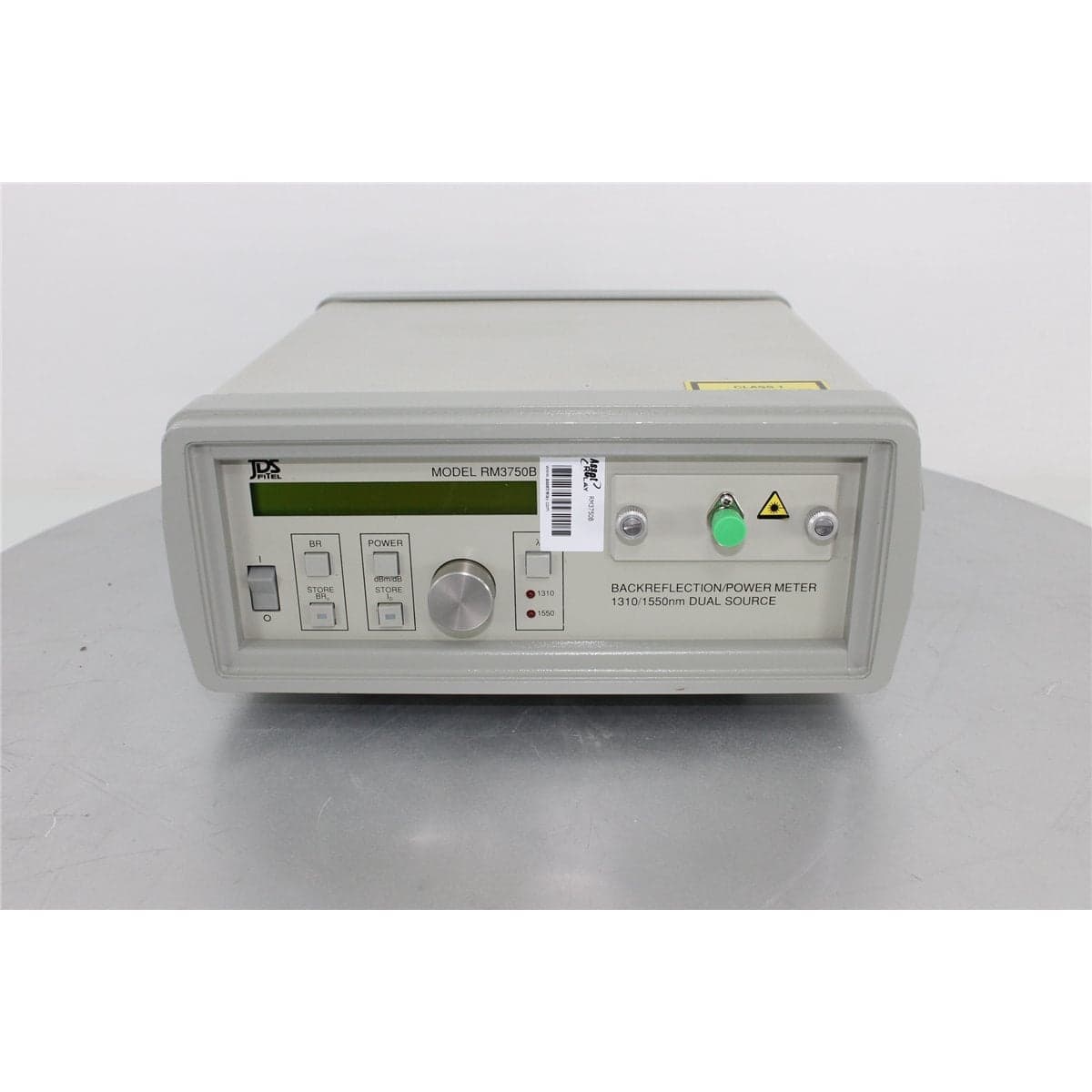
JDS · RM3750B
JDS Uniphase RM3750B 1550 nm Single-Mode Backreflection and Insertion Loss Meter
$3,192.00
Price in USD.
- Condition
- Used
- Availability
- In stock · 3 available
- Model
- RM3750B
- Manufacturer
- JDS
- Category
- Back Reflection Meters (BRM)
Description
JDS Uniphase RM3750B 1550 nm Backreflection Meter
The JDS Uniphase RM3750B is a portable optical test instrument designed for direct measurement of backreflection, insertion loss, and optical power in single-mode fiber optic connectors, cable assemblies, passive components, and installed systems. Its integrated 1550 nm optical source and single output port make it particularly useful for jumper manufacturing, connector qualification, incoming inspection, installation verification, and production quality control.
The meter uses an FC/APC ultra-low-backreflection output connector. Compatible hybrid test jumpers can adapt the instrument to different connector types while preserving the measurement range required for low-reflection testing. When the device under test is connected and its far end is properly terminated, the instrument directly displays the measured backreflection.
The RM3750B provides a 0 dB to -75 dB backreflection range for supported 9/125 µm single-mode measurements. It also measures insertion loss and optical power down to -80 dBm. A 2 mm InGaAs detector, compensation for extraneous reflections, user-adjustable calibration, rechargeable battery operation, and serial communication support both benchtop and portable test workflows.
Features and Benefits of the JDS Uniphase RM3750B
- 1550 nm optical source: Supports testing of compatible single-mode components and systems at a key telecommunications wavelength.
- Backreflection measurement: Measures supported single-mode reflections over a range from 0 dB to -75 dB.
- Insertion loss measurement: Evaluates optical loss through connectors, jumpers, passive components, and fiber paths.
- Optical power measurement: Provides direct power measurements down to -80 dBm.
- Single FC/APC output: Uses an ultra-low-backreflection source connection suitable for hybrid measurement jumpers.
- Direct-reading display: Displays backreflection, insertion loss, or optical power on the integrated 16-character LCD.
- Extraneous-reflection compensation: Compensates for unwanted reflections in the optical setup to improve backreflection measurement confidence.
- User-adjustable calibration: Allows calibration to be checked and adjusted using suitable calibrated reference jumpers.
- Rechargeable battery: Supports portable operation for production-floor and field-testing applications.
- RS-232 interface: Enables data logging to a compatible computer or serial printer.
- Optional foot-pedal operation: Supports convenient hands-free recording during repetitive connector and jumper tests.
- Portable construction: Compact dimensions and an available transit case support transportation between test locations.
Backreflection Measurement
Backreflection is the portion of incident optical power reflected toward the source by a connector, component, splice, or other discontinuity. Excessive reflection can affect lasers, optical amplifiers, transmitters, and other reflection-sensitive equipment.
The RM3750B directly measures the backreflection of a connected device under test. The DUT is connected through a suitable reference jumper, and the far end is terminated using an appropriate low-reflection method. The measured result is then shown on the instrument display.
For supported 9/125 µm single-mode configurations, the meter provides a backreflection range from 0 dB to -75 dB. Relative backreflection accuracy is specified at ±0.4 dB under the documented conditions, with additional uncertainty at the lowest reflection levels.
Insertion Loss Measurement
The RM3750B measures the optical loss introduced by connectors, jumpers, adapters, passive components, and fiber optic systems. A reference measurement is established before the device under test is inserted into the optical path.
Relative power accuracy is specified at ±0.05 dB for measurements involving less than 5 dB of loss and ±0.15 dB for measurements involving more than 5 dB of loss. Additional uncertainty applies near the lowest supported power levels.
Reference jumpers and optical connections should remain clean and mechanically stable throughout the measurement sequence. If a reference connection is disconnected, cleaned, or moved, the reference should be checked again before additional measurements are accepted.
Optical Power Measurement
The integrated 2 mm InGaAs detector supports single-mode optical power measurements from 0 dBm to -80 dBm. Typical absolute power accuracy is ±0.25 dB at -10 dBm when the documented dark-measurement procedure is followed.
Power mode can be used to verify source output, confirm optical continuity, evaluate received signal levels, and support insertion loss or backreflection test setup. A fresh dark measurement should be performed when required for low-level optical power measurements.
1550 nm Single-Mode Configuration
The RM3750B is configured with a nominal 1550 nm source for testing compatible C-band single-mode components. The documented source wavelength tolerance for single-mode RM3 meters is ±10 nm.
The instrument is intended for use with 9/125 µm single-mode fiber. Compatible single-mode reference jumpers, hybrid cables, adapters, and terminations should be used throughout the measurement path.
The source wavelength and fiber type should match the device under test and the required test procedure. Performance at unrelated wavelengths should not be assumed from the 1550 nm configuration.
FC/APC Ultra-Low-Reflection Output
The meter uses an FC/APC source output to minimize reflection at the instrument interface. The angled connector geometry helps prevent the source connection from limiting the available backreflection measurement range.
Hybrid jumpers can be used to connect the FC/APC output to devices with FC/PC, SC/PC, SC/APC, LC, ST, or other compatible interfaces. The actual jumper must be suitable for the connector type and polish being tested.
FC/APC and FC/PC connectors must not be directly intermated. Their ferrule geometries differ and direct mating can cause high insertion loss, poor reflection performance, and physical damage.
Extraneous-Reflection Compensation
Unwanted reflections from reference jumpers, adapters, connectors, and open fiber ends can affect a backreflection measurement. The RM3750B provides compensation for extraneous reflections so the displayed result more accurately represents the device under test.
The compensation procedure should be completed using the same jumper and optical setup intended for the final measurement. Changing a jumper, adapter, or termination after compensation can alter the residual reflection and affect measurement accuracy.
User Calibration and Reference Verification
The RM3750B provides a user-calibration mode for adjusting or checking measurement response. Suitable calibrated reference jumpers can be used to verify backreflection performance.
Calibration verification is useful for daily production checks, incoming inspection stations, and quality-control environments. Reference devices must remain clean, protected, and within their stated calibration interval.
A user adjustment does not replace formal calibration when traceable measurements are required. The instrument, source, detector, internal optics, and reference standards should be evaluated as a complete measurement system.
Portable Battery Operation
An internal rechargeable battery supports use away from a fixed AC outlet. Portable operation is useful for installation verification, production-floor testing, equipment servicing, and measurements at different locations.
Battery condition and operating time depend on age, charging history, storage, and instrument usage. The battery should be tested when extended portable operation is required.
The instrument also accepts universal AC input from 100 V to 240 V at 50 Hz to 60 Hz. Maximum power consumption is 30 VA.
RS-232 Data Logging
The standard RS-232 interface supports communication with a compatible computer or serial printer. Measurement results can be recorded for production documentation, component traceability, quality-control records, and test reports.
An optional foot pedal allows an operator to trigger data logging while handling connectors or jumper assemblies. This can improve efficiency during repetitive production testing.
Multiple Connector Test System application software may be used with compatible configurations. Software, cables, foot pedals, computers, and printers should be considered included only when specifically identified in the product listing.
Typical Applications
- Fiber optic connector backreflection testing
- Single-mode jumper and patch-cord qualification
- Insertion loss measurement
- Optical power measurement
- Passive component testing
- Connector manufacturing and inspection
- Fiber optic installation verification
- Production quality assurance
- Incoming component acceptance testing
- Telecommunications laboratory measurements
- Field service and maintenance
- Computerized measurement data logging
Product Overview
| Brand | JDS Uniphase |
| Model | RM3750B |
| Product Series | RM3 Series |
| Product Category | Backreflection, Insertion Loss and Optical Power Meter |
| Nominal Source Wavelength | 1550 nm |
| Fiber Type | 9/125 µm single-mode fiber |
| Output Interface | FC/APC ultra-low-backreflection connector |
| Measurement Functions | Backreflection, insertion loss, and optical power |
| Remote Interface | RS-232 standard; GPIB optional on supported configurations |
| Primary Application | 1550 nm connector, jumper, component, and single-mode system testing |
Optical Specifications
| Specification | Details |
| Nominal Operating Wavelength | 1550 nm |
| Source Wavelength Tolerance | ±10 nm |
| Fiber Type | 9/125 µm single-mode |
| Detector Type | 2 mm InGaAs |
| Backreflection Range | 0 dB to -75 dB |
| Relative Backreflection Accuracy | ±0.4 dB under the documented conditions |
| Optical Power Range | 0 dBm to -80 dBm |
| Typical Absolute Power Accuracy | ±0.25 dB at -10 dBm |
| Relative Power Accuracy Below 5 dB Loss | ±0.05 dB |
| Relative Power Accuracy Above 5 dB Loss | ±0.15 dB |
Low-Level Backreflection Accuracy Considerations
| Backreflection Reading | Additional Typical Uncertainty |
| -60 dB to -67 dB | Add ±0.4 dB |
| -67 dB to -72 dB | Add ±0.8 dB |
| -72 dB to -75 dB | Add ±1.5 dB |
System Specifications
| Specification | Details |
| Display | 16-character LCD |
| Standard Remote Interface | RS-232 |
| Optional Remote Interface | GPIB on supported configurations |
| Portable Power | Internal rechargeable battery |
| Data-Logging Support | Compatible computer or serial printer |
| Optional Data-Logging Control | Foot pedal |
| Calibration Features | User-adjustable calibration and reference-jumper verification |
| Reflection Compensation | Compensation for extraneous backreflection |
Physical and Environmental Specifications
| Specification | Details |
| Width | 26 cm |
| Height | 11 cm |
| Depth | 26 cm |
| Weight | Approximately 4 kg |
| Operating Temperature | 0 °C to 40 °C |
| Storage Temperature | -40 °C to 70 °C |
| Maximum Humidity | 95% relative humidity from 0 °C to 40 °C |
Electrical and Safety Specifications
| Specification | Details |
| AC Input Voltage | 100 V to 240 V AC |
| Line Frequency | 50 Hz to 60 Hz |
| Maximum Power Consumption | 30 VA |
| Laser Classification | Class 1 under IEC 60825-1:2002 for the documented RM3 configuration |
| Documented Compliance | CE requirements, UL 3101-1, and CAN/CSA-C22.2 No. 1010.1 |
Measurement Setup
The meter, reference jumper, and device under test should be allowed to stabilize before precision measurements are performed. All optical interfaces should be inspected and cleaned before connection.
A suitable FC/APC reference or hybrid jumper should be connected to the meter output. The jumper should match the connector type and polish of the device under test without introducing an unsupported direct interface.
The instrument should be referenced or calibrated according to the selected backreflection, insertion loss, or power measurement procedure. The DUT output should be terminated appropriately during backreflection testing.
For low-level power measurements, a dark measurement should be completed immediately before the optical reading. The jumper and DUT should remain mechanically stable while the measurement is acquired.
Comprehensive Functional and Performance Testing
The JDS Uniphase RM3750B receives comprehensive functional and performance testing before shipment. Evaluation may include AC operation, rechargeable battery operation, startup, LCD condition, front-panel controls, measurement-mode selection, source output, detector response, calibration functions, and RS-232 communication.
Optical testing may include verification of the 1550 nm source, backreflection response, insertion loss measurement, optical power measurement, extraneous-reflection compensation, and repeatability using suitable reference jumpers and calibrated optical standards.
The FC/APC output port, detector interface, internal battery, communication port, optional foot-pedal interface, power inlet, enclosure, carrying case, model label, and calibration label may be inspected for damage or excessive wear.
The exact testing scope depends on available calibrated backreflection references, insertion-loss standards, optical power standards, reference jumpers, connector interfaces, termination methods, and communication accessories.
Calibration Before Shipment
When technically applicable and selected, the JDS Uniphase RM3750B can be calibrated or performance-verified before shipment. Calibration may include source wavelength, source power, backreflection response, insertion loss accuracy, optical power accuracy, detector linearity, reflection compensation, and serial communication.
A complete calibration should identify the instrument model and serial number, test wavelength, fiber type, jumper configuration, connector interfaces, optical power levels, backreflection standards, insertion-loss standards, recorded measurements, and applicable uncertainty.
Buyers requiring formal calibration should specify the desired backreflection levels, insertion-loss values, optical power points, connector types, certificate format, recorded data, and measurement uncertainty before purchase.
Buyer Considerations
Buyers should confirm that the instrument is labelled JDS Uniphase RM3750B and verify its installed 1550 nm source, 9/125 µm single-mode configuration, and FC/APC output interface.
The product listing should identify whether reference jumpers, hybrid test cables, calibrated backreflection jumpers, detector adapters, termination accessories, foot pedal, serial cable, GPIB option, carrying case, battery, power cord, manuals, or calibration records are included.
The condition of the optical output, detector input, display, controls, rechargeable battery, RS-232 interface, optional GPIB interface, foot-pedal connection, power inlet, enclosure, case, and calibration labels should be reviewed before purchase.
Only the RM3750B meter and accessories specifically identified in the product listing should be considered included.
Why Buy from AssetRelay?
AssetRelay supplies professional equipment and product solutions for fiber optics, telecom, laboratory, production, optical testing, photonics, inspection, cleaning, electronic testing, RF/microwave, and technical research applications. The JDS Uniphase RM3750B provides integrated backreflection, insertion loss, and optical power measurement for jumper manufacturers, connector producers, telecommunications laboratories, production facilities, installers, service organizations, and quality-assurance teams.
Buyers should review the product photographs, complete model identification, source wavelength, fiber type, FC/APC output condition, included reference jumpers, battery condition, remote interface, calibration status, functional test results, and included accessories before purchase.