
Melles-Griot · 13SKP543
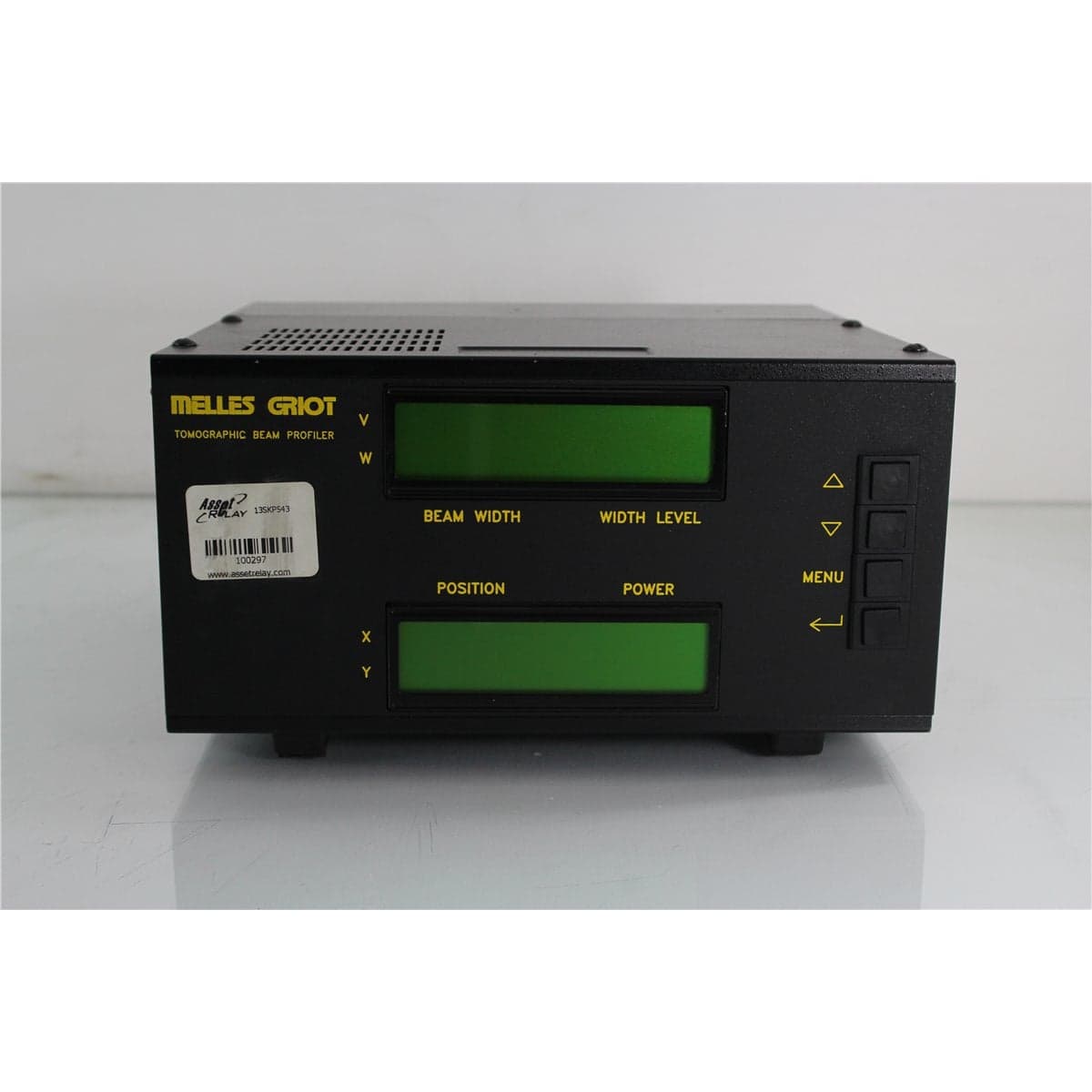
Melles Griot 13SKP543 Super BeamAlyzer InGaAs Laser Beam Profiler System
$3,192.00
Price in USD.
- Condition
- Used
- Availability
- In stock
- Model
- 13SKP543
- Manufacturer
- Melles-Griot
- Category
- Laser Beam Analysers
Description
Melles Griot 13SKP543 Super BeamAlyzer Laser Beam Profiler System
The Melles Griot 13SKP543 Super BeamAlyzer is a stand-alone laser beam analysis and tomographic profiling system designed for precise characterization of near-infrared laser beams. The system combines several important optical measurement functions in one platform, including beam power measurement, beam position tracking, beam size measurement, beam profile analysis, and beam noise analysis.
The 13SKP543 configuration includes a stand-alone controller and a seven-blade Super BeamAlyzer measurement head. The head uses an InGaAs detector with a 3 mm round aperture and supports optical sources from 800 nm to 1800 nm. This spectral coverage makes the system suitable for compatible semiconductor lasers, fiber-coupled sources, telecommunications lasers, solid-state lasers, and other near-infrared optical systems.
The seven-blade tomographic measurement architecture samples the optical beam from multiple directions. This approach allows the system to reconstruct and analyze important beam characteristics without relying solely on a conventional camera sensor. The resulting measurements can support laser alignment, beam-quality evaluation, optical system development, production testing, and troubleshooting.
The maximum permitted optical input depends on wavelength. The documented limits are 20 mW from 800 nm to 1000 nm, 3 mW at 1300 nm and 1550 nm, and 20 mW at 1800 nm. Optical power should be measured before the beam is applied to the analyzer, especially when the laser output is unknown or can exceed the detector limit.
Features and Benefits of the Melles Griot 13SKP543
The Melles Griot 13SKP543 provides an integrated platform for professional users who require detailed analysis of laser beam power, position, dimensions, profiles, and stability.
- Stand-alone beam analysis system: Includes a dedicated controller and Super BeamAlyzer measurement head for laboratory and production use.
- Seven-blade tomographic profiler: Samples the beam from multiple directions to support reconstruction and analysis of the optical profile.
- InGaAs detector: Provides sensitivity across a broad near-infrared wavelength range.
- 800 nm to 1800 nm spectral response: Supports compatible near-infrared laser sources, including common telecommunications wavelengths.
- 3 mm round aperture: Provides a defined optical entrance area for compatible beams.
- Beam power measurement: Supports measurement and monitoring of compatible optical power levels.
- Beam position tracking: Helps monitor beam movement and alignment changes over time.
- Beam size analysis: Supports evaluation of the dimensions of the incident optical beam.
- Beam profile analysis: Provides information about the spatial distribution of optical energy.
- Beam noise analysis: Helps characterize fluctuations and instability in compatible laser sources.
- Telecommunications wavelength support: Covers common near-infrared wavelengths near 1300 nm and 1550 nm.
- Professional optical testing: Suitable for laser development, alignment, quality control, research, and production applications.
Seven-Blade Tomographic Beam Analysis
The Super BeamAlyzer head uses a seven-blade arrangement to sample the laser beam from multiple orientations. Each blade contributes information about the beam’s spatial distribution, allowing the measurement system to reconstruct key profile characteristics.
Tomographic analysis is useful when the user must understand more than total optical power. The system can help evaluate how optical energy is distributed across the beam, whether the beam remains centered, and whether the beam shape changes during alignment, adjustment, or extended operation.
The seven-blade design also supports beam analysis without exposing a complete imaging array directly to the incident laser. The exact measurement sequence, scan method, reconstruction algorithm, and displayed parameters depend on the system controller and operating configuration.
InGaAs Detector for Near-Infrared Lasers
The 13SKP543 uses an indium gallium arsenide detector. InGaAs detector technology provides useful sensitivity across the near-infrared region covered by the system’s documented 800 nm to 1800 nm spectral response.
This broad response allows the instrument to work with compatible sources near 850 nm, 980 nm, 1064 nm, 1300 nm, 1310 nm, 1480 nm, 1550 nm, and other wavelengths within the supported range.
Detector response and maximum safe power vary with wavelength. The operator should confirm the source wavelength and optical power before beginning a measurement. Appropriate attenuation should be used whenever the source can exceed the documented detector limit.
Beam Power Measurement
The Super BeamAlyzer combines beam profiling with optical power measurement. This allows the user to observe the spatial characteristics of the beam while also monitoring the applied optical level.
Power measurement is useful when comparing profile changes at different source settings, checking output stability, evaluating alignment losses, or confirming that the detector remains within its supported input range.
The documented wavelength-dependent power limits must not be exceeded. A separate calibrated optical power meter may be used to verify the incident level before the laser beam is directed into the 13SKP543 head.
Beam Position Tracking
Beam position tracking helps determine whether the optical beam remains centered relative to the analyzer aperture and measurement axis. This function can support alignment of lasers, fiber collimators, optical mounts, lenses, and beam-delivery systems.
Position measurements can also reveal beam drift caused by source warm-up, temperature changes, mechanical movement, vibration, or instability within the optical setup.
For meaningful comparisons, the Super BeamAlyzer head should be mounted securely, and the surrounding optical hardware should remain mechanically stable throughout the measurement interval.
Beam Size and Profile Analysis
The 13SKP543 supports measurement of beam dimensions and spatial profile characteristics. These measurements help users determine whether the laser output meets the requirements of the optical system or process.
Beam size information is useful for matching a laser to lenses, apertures, fiber couplers, detectors, modulators, and other components. Profile analysis can help identify asymmetry, clipping, spatial distortion, or other conditions that may not be apparent from total power alone.
The beam should fit within the 3 mm round aperture throughout the complete measurement process. A beam that is too large, significantly displaced, or improperly aligned may be clipped and can produce incomplete or misleading results.
Beam Noise and Stability Analysis
The Super BeamAlyzer includes beam noise analysis for evaluating fluctuations in compatible optical sources. Noise measurements can support the characterization of laser stability during development, production testing, or laboratory operation.
Observed fluctuations may be associated with the laser source, current driver, temperature controller, optical feedback, mechanical vibration, air movement, or another element within the optical setup.
Stable mounting, controlled environmental conditions, and suitable source warm-up help distinguish true laser fluctuations from changes caused by the external measurement arrangement.
Wavelength-Dependent Maximum Power Limits
The maximum permitted optical power varies across the detector’s spectral range. The lower maximum at 1300 nm and 1550 nm is especially important for telecommunications and fiber optic laser testing.
| Wavelength or Range | Maximum Optical Power |
| 800 nm to 1000 nm | 20 mW |
| 1300 nm | 3 mW |
| 1550 nm | 3 mW |
| 1800 nm | 20 mW |
When the source level is unknown, the beam should be measured through an appropriate external attenuator before it is applied to the analyzer. Attenuator wavelength compatibility and power handling should be verified before use.
Typical Applications
The Melles Griot 13SKP543 Super BeamAlyzer is suitable for professional applications such as:
- Near-infrared laser beam profiling
- Laser beam power measurement
- Beam position and alignment monitoring
- Beam size measurement
- Spatial profile characterization
- Laser noise and stability analysis
- 1300 nm and 1550 nm telecommunications laser testing
- Semiconductor laser characterization
- Fiber-coupled source alignment
- Optical component development
- Production and quality-control testing
- Photonics laboratory research
Product Overview
| Brand | Melles Griot |
| Model | 13SKP543 |
| Product Name | Super BeamAlyzer |
| Product Category | Stand-Alone Laser Beam Analyzer and Tomographic Beam Profiler |
| Detector Type | InGaAs |
| Spectral Response | 800 nm to 1800 nm |
| Optical Aperture | 3 mm round aperture |
| Measurement Head | Seven-blade Super BeamAlyzer head |
| System Controller | Stand-alone controller |
| Primary Application | Near-infrared laser beam power, position, size, profile, and noise analysis |
Confirmed Specifications
| Specification | Details |
| Model Number | 13SKP543 |
| System Type | Stand-alone laser beam analysis and tomographic profiling system |
| Included System Components | Stand-alone controller and seven-blade Super BeamAlyzer head |
| Detector Material | Indium gallium arsenide |
| Spectral Response | 800 nm to 1800 nm |
| Aperture | 3 mm round |
| Maximum Power from 800 nm to 1000 nm | 20 mW |
| Maximum Power at 1300 nm | 3 mW |
| Maximum Power at 1550 nm | 3 mW |
| Maximum Power at 1800 nm | 20 mW |
| Core Measurement Functions | Beam power, position, size, profile, and noise analysis |
Configuration Details Requiring Verification
| Configuration Item | Verification Required |
| Controller Interface | Confirm the available controls, display, communication ports, and data-output functions |
| Head Connection | Confirm the required head cable, connector, and controller compatibility |
| Beam-Size Measurement Range | Verify the supported minimum and maximum dimensions for the installed head |
| Position Measurement Range | Confirm the measurable beam displacement within the 3 mm aperture |
| Power Accuracy | Verify from unit-specific documentation or current performance testing |
| Profile Parameters | Confirm the available calculated beam dimensions, centroids, noise values, and profile formats |
| Data Storage and Software | Confirm whether external software, communication cables, or storage accessories are required |
| AC Power Requirements | Verify the controller input voltage, frequency, fuse, and power-cord requirements |
Installation and Alignment
The Super BeamAlyzer head should be mounted on a clean, stable, and vibration-resistant optical support. The head must be positioned so the incident beam is directed into the center of the 3 mm aperture.
Initial alignment should be performed at reduced optical power whenever practical. A suitable viewing card, alignment target, attenuator, or low-power pilot beam can be used when compatible with the source wavelength.
The complete beam should remain within the aperture during measurement. Beam clipping can alter measured power, position, size, and profile results.
The analyzer head and controller should be connected using the correct system cable before power is applied. All controls, interfaces, and head identification should be verified during startup.
Detector Care and Optical Safety
The analyzer aperture and internal detector assembly are precision optical components. Dust, oils, residue, scratches, and physical contact can affect the measurement response.
The detector opening should not be touched or cleaned using unapproved materials. A protective cover should remain installed whenever the measurement head is not in use.
The 13SKP543 measures invisible near-infrared laser radiation. The absence of visible light does not indicate that the source is disabled. Users should not look into the analyzer head, laser source, patch cord, or exposed optical path.
Suitable laser-safety procedures, protective eyewear, beam blocks, enclosures, warning signs, and controlled working practices should be used according to the source wavelength and optical power.
Comprehensive Functional and Performance Testing
The Melles Griot 13SKP543 receives comprehensive functional and performance testing before shipment. Evaluation may include controller startup, display and control operation, analyzer-head recognition, blade movement, detector response, power measurement, and communication between the controller and seven-blade head.
Optical testing may include representative measurements within the 800 nm to 1800 nm detector range using suitable attenuated sources. Evaluation may include beam position response, size analysis, profile reconstruction, power response, and noise analysis when compatible calibrated equipment is available.
The controller, analyzer head, seven-blade mechanism, InGaAs detector aperture, system cable, connectors, controls, display, housing, mounting interfaces, identification labels, and laser-safety markings may be inspected for contamination, damage, corrosion, unauthorized modification, or excessive wear.
The exact testing scope depends on the available laser wavelengths, calibrated optical power meter, beam-conditioning optics, attenuators, stable mounting hardware, controller accessories, and required measurement parameters.
Performance Verification Before Shipment
When technically applicable and selected, the Melles Griot 13SKP543 can be performance-verified before shipment. Evaluation may include detector response, power measurement, beam position response, beam-size analysis, profile reconstruction, noise measurement, and wavelength-dependent operation.
Performance documentation should identify the controller and analyzer-head serial numbers, laser wavelength, incident optical power, beam dimensions, attenuation, mounting arrangement, measurement settings, reference instruments, environmental conditions, recorded results, and applicable measurement uncertainty.
Buyers requiring specific recorded measurements should identify the required wavelengths, beam sizes, optical power levels, profile parameters, stability interval, report format, and measurement uncertainty before purchase.
Why Buy from AssetRelay?
AssetRelay supplies professional equipment and product solutions for laser beam analysis, photonics, optical testing, fiber optics, telecommunications, laboratory, production, inspection, electronic testing, RF/microwave, and technical research applications. The Melles Griot 13SKP543 supports laser manufacturers, optical laboratories, production facilities, system integrators, universities, and photonics research organizations.
Buyers should review the stand-alone controller, seven-blade Super BeamAlyzer head, InGaAs detector, 3 mm aperture, 800 nm to 1800 nm spectral range, wavelength-dependent power limits, system cable, functional test results, performance-verification status, and included accessories before purchase.